

Singapore Airlines delivered a record top line and a record operating profit, but reported net profit fell sharply. Group revenue rose 5.0% to SGD 20,522 million (USD 16,130 million), and operating profit jumped 39.0% to SGD 2,375 million (USD 1,867 million) — the strongest operating result the Singapore Airlines Group has ever produced. Yet net profit attributable to shareholders dropped 57.4%, from SGD 2,778 million (USD 2,183 million) to SGD 1,184 million (USD 930 million).
The dissonance between a record operational year and a halved bottom line is almost entirely a story about Air India. Strip that out, and the underlying business performed exceptionally well.
The Underlying Airline Business Is Strong
On core operating metrics, FY2025/26 was a great year. The Group (Singapore Airlines and Scoot) carried a record 42.4 million passengers (up 7.7% year-on-year), passenger load factor rose 1.1 points to 87.7%, and passenger yields edged up 1.0% to 10.4 cents per RPK. Traffic growth of 4.7% comfortably outpaced capacity expansion of 3.4%, indicating disciplined supply management against robust demand.
The second half of the fiscal year was particularly strong: operating profit of SGD 1,572 million (USD 1,236 million) was up 72.0% year-on-year, the best second half in the Group’s history, helped by a swing from fuel hedging losses to gains as forward fuel prices rose with the Middle East conflict.
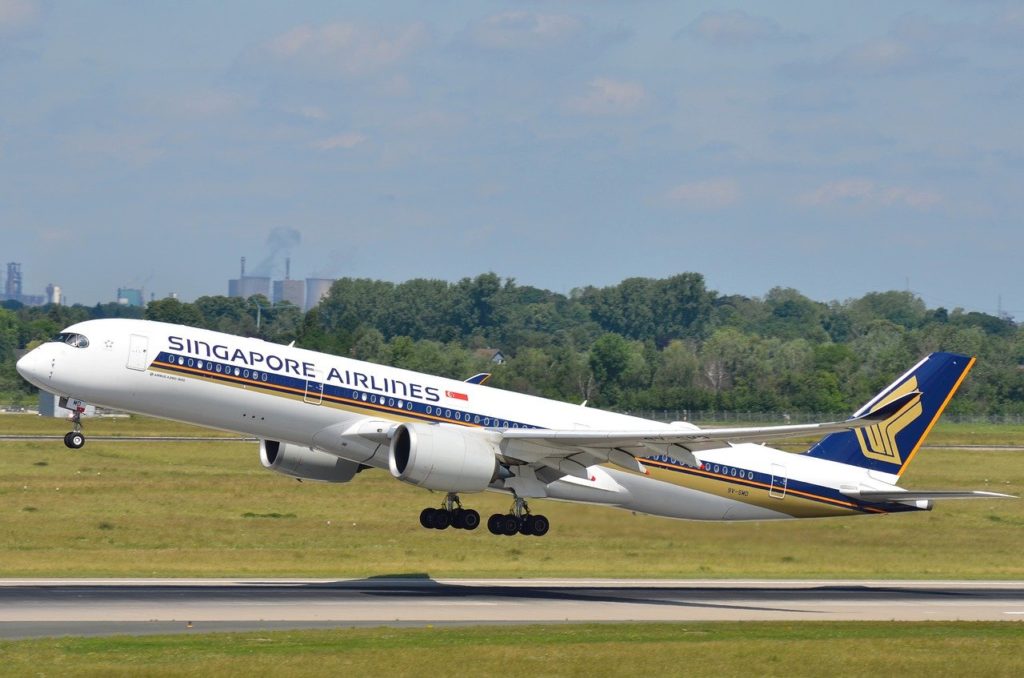
Air India: The Story Behind the Headline Drop
The Group’s exposure to Air India is reflected in two related lines in the accounts, and together they account for almost the entirety of the year-on-year drop in net profit.
1. The disappearance of last year’s SGD 1,098 million (USD 863 million) one-off gain. When Vistara — the Tata-SIA joint venture — merged into Air India in November 2024, SIA recognised a non-cash accounting gain of SGD 1,097.9 million on the disposal of its stake in Vistara, with its holding effectively rolled into a 25.1% interest in the enlarged Air India. That gain inflated FY2024/25’s reported profit and was always going to leave a hole in the year-on-year comparison. It is gone in FY2025/26.
2. Share of associated companies swung from a small profit to a large loss. This is the more important and ongoing effect. The Group’s share of associated companies’ results moved from a profit of SGD 17.1 million (USD 13 million) in FY2024/25 to a loss of SGD 828.5 million (USD 651 million) in FY2025/26 — a swing of roughly SGD 846 million (USD 665 million). Looking at the segment disclosure, the Full-Service Carrier segment alone booked an SGD 940.4 million (USD 739 million) share of associated losses, versus just SGD 64.2 million (USD 50 million) the year before. Management is explicit about the cause: the Group is now recognising twelve months of its share of Air India’s losses, whereas FY2024/25 only included roughly four months of post-merger losses.
In other words, FY2024/25 contained a large one-off accounting gain from Air India and only a partial-year share of its losses. FY2025/26 contains no offsetting gain and a full year of losses. The arithmetic alone — adding back the SGD 1,098 million gain and roughly two-thirds of the way through the SGD 846 million loss swing — accounts for the bulk of the SGD 1,594 million (USD 1,253 million) decline in net profit.
3. The balance sheet reflects the impairment of carrying value. Investments in associated companies fell from SGD 2,865.2 million (USD 2,252 million) to SGD 2,018.8 million (USD 1,587 million), down SGD 846 million (USD 665 million) — closely tracking the recognised losses. The Air India stake is being progressively written down through equity accounting as Tata-led integration costs, fleet renewal and turnaround spending flow through the joint entity’s profit and loss.
Was this a bad strategic move? Not necessarily — and it is worth separating the accounting from the strategy. Equity-accounted losses during an integration phase are normal for a turnaround of this scale (Air India is being rebuilt by Tata into a full-service flag carrier with a re-fleeted aircraft base). SIA retains a 25.1% stake in what is now the dominant Indian airline group, providing it with strategic exposure to one of the world’s fastest-growing aviation markets. The question for investors is whether the Indian growth story will eventually justify the J-curve of integration losses now hitting the P&L. Engineering services associates partly cushioned the headline number, contributing SGD 111.9 million (USD 88 million) in their share of profits.
Balance Sheet and Cash Flow
The balance sheet remains robust. Equity attributable to owners rose 10.3% to SGD 17,262 million (USD 13,568 million), helped by SGD 916 million (US$720M) from the conversion of the 2025 convertible bonds into 179 million new shares, plus SGD 716 million (USD 563 million) of fair value gains on cash flow hedges (mainly fuel) as forward prices rose. Cash and bank balances stood at SGD 7,931 million (USD 6,234 million) — down only SGD 326 million (USD 256 million) despite a heavy year of capital deployment.
Capital Returns
Despite the lower headline profit, the Board has been generous with shareholders. The total dividend declared for FY2025/26 is 37 cents (SGD) per share (22 cents final ordinary + 7 cents special final + 5 cents interim ordinary + 3 cents interim special), totalling SGD 1,166 million (USD 916 million). That is only modestly below the SGD 1,207 million (USD 949 million) paid out for FY2024/25 despite net profit more than halving — and notably, this is the first time the Group has paid a special dividend in recent reporting cycles, signalling confidence in underlying cash generation even with the Air India drag.
Outlook
Management has flagged the Middle East conflict as the main near-term headwind, with jet fuel prices having more than doubled since the conflict began. Because fuel is priced on a lag and partly hedged, the full effect is yet to feed through and is expected to land squarely in FY2026/27. Fare increases across SIA and Scoot’s networks have not fully offset the rise in fuel costs.
The bigger structural question for FY2026/27 and beyond is when Air India turns. Until then, equity-accounted losses will continue to depress reported earnings even while the core airline operations perform well. Investors should carefully distinguish between the underlying business — which is producing record operating profits, record passenger numbers, strong load factors, and rising yields — and the Air India accounting drag, which is a non-cash equity-method allocation that does not affect Group cash flow or solvency.
Bottom Line
FY2025/26 is best read as two stories. Operationally, this is the strongest year Singapore Airlines has had: record revenue, record operating profit, record passengers, record load factor. Reported net profit, however, was dragged down by the absence of FY2024/25’s SGD 1,098 million (USD 863 million) one-off Vistara merger gain and by a full year of equity-accounted Air India losses totalling around SGD 940 million (USD 739 million) in the FSC segment. The SGD 1,594 million (USD 1,253 million) decline in net profit is attributable entirely to Air India-related accounting effects rather than to any deterioration in the core flying business. Whether the Air India stake ultimately rewards shareholders depends on the success of the Tata-led integration over the next several years; in the meantime, expect continued equity losses to weigh on reported earnings, even as the underlying SIA and Scoot franchises continue to perform strongly.
Liked our articles and our efforts? Please pay an amount you are comfortable with; an amount you believe is the fair price for the content you have consumed. Please enter an amount in the box below and click on the button to pay; you can use Netbanking, Debit/Credit Cards, UPI, QR codes, or any Wallet to pay. Every contribution helps cover the cost of the content generated for your benefit.
(Important: to receive confirmation and details of your transaction, please enter a valid email address in the pop-up form that will appear after you click the ‘Pay Now’ button. For international transactions, use Paypal to process the transaction.)
We are not putting our articles behind any paywall where you are asked to pay before you read an article. We are asking you to pay after you have read the article if you are satisfied with the quality and our efforts.


Leave a Reply