

After more than a decade of talk, missed deadlines to open, and political wrangling, Noida International Airport (DXN) has finally crossed the finish line. The greenfield airport at Jewar was inaugurated by Prime Minister Narendra Modi on March 28, 2026, and commercial passenger flights are now set to begin from June 15, 2026, with IndiGo as the launch carrier.
For Delhi-NCR, this is a long-awaited moment. India’s most congested airport — IGI — finally gets a sister facility about 100 km to the southeast, designed to handle 12 million passengers per annum (MPPA) in Phase 1, scalable to 70 MPPA when it is fully implemented. The terminal is striking, the runway is brand-new, and the operator, Yamuna International Airport Private Limited (YIAPL) — a wholly owned subsidiary of Zurich Airport International — has been touting the airport as India’s first net-zero greenfield hub.
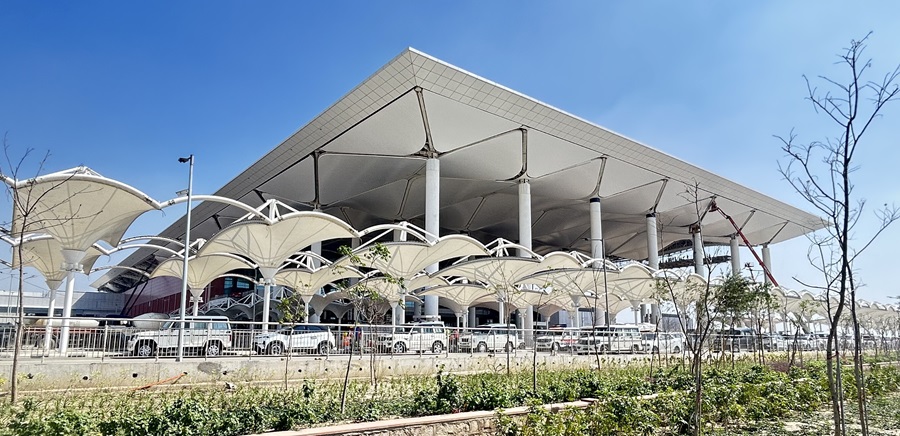
Noida International Airport
But here’s the awkward part of the launch story that nobody quite wants to lead with: flying out of Noida is going to cost you more than flying out of Delhi. And not by a small margin.
The Fee Structure Nobody Expected
When the proposed tariff structure for Noida International Airport was first filed with the Airports Economic Regulatory Authority (AERA), airlines did a double-take. The numbers, frankly, didn’t fit the script of a “complementary” second airport designed to ease pressure on Delhi. The responses from all stakeholders in the comments on the proposed tariff indicated that Noida Airport was outpricing itself compared to Delhi Airport. And while everyone had thoughts, IndiGo added numbers to the mix.
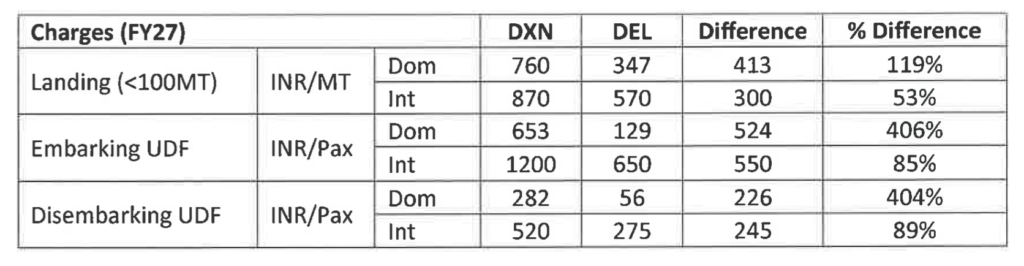
According to IndiGo, an A321neo (the larger brother of the A320) will cost 1,88,000 INR more to operate from DXN at full capacity, which works out to an extra INR 475 per passenger compared to Delhi. Connectivity is not available at Noida Airport for now, so it will be very hard to get people in.
The thing to remember is that this is a situation where both airports are operated by different groups, with the more established Delhi Airport operated by the GMR Group and the greenfield Noida Airport by a subsidiary of Zurich Airport. This is different from the Mumbai situation, where both Mumbai and Navi Mumbai airports are operated by Adani Airports. When GMR launched Mopa Airport, it was solving a real problem: providing an airport that could operate 24×7 and not be in shambles, unlike Dabolim Airport, with which it was competing. In this case, Noida needs to be aggressive with pricing before considering recovering its investments.
IndiGo’s Math: INR 103 Crore a Year
The pushback from airlines has been unusually public, and IndiGo has done most of the heavy lifting on the numbers. In its submission to AERA, the airline laid out a stark scenario based on the originally proposed charges:
- A single domestic A321 round-trip would cost INR 1.88 lakh more at Noida than at Delhi.
- If IndiGo operated 15 daily round-trips from Noida, the airline would incur roughly ₹103 crore in additional annual costs versus running the same operation from IGI.
IndiGo’s submission warned that, at those rates, “NIA will become commercially unattractive for operations at any meaningful scale.” Translation: if the maths doesn’t work for airlines, the maths certainly won’t work for passengers, because that cost gets passed straight through to the ticket.
AERA Steps In — Partially
After significant pushback from airlines, MLAs and the press, AERA issued its tariff order, moderating the headline User Development Fee (UDF) numbers downward:
| AERA-approved UDF (2026-27) | Noida | Delhi |
|---|---|---|
| Domestic departure | INR 490 | INR 129 |
| Domestic arrival | INR 210 | INR 56 |
| International departure | INR 980 | INR 650 |
| International arrival | INR 420 | INR 275 |
Better, but still not exactly cheap. Even after the haircut, Noida’s domestic departure UDF is roughly 280% higher than Delhi’s. A family of four flying out of Noida domestically will pay close to INR 2,000 in UDF alone, versus around INR 500 from Delhi. Multiply that by the millions of passengers expected through Phase 1, and the gap becomes structural — not a rounding error.
The variable landing and parking tariff has been retained, with AERA structuring it to incentivise airlines to launch new routes and ramp up frequency in the early years. But the fundamental cost-recovery framework — designed to enable YIAPL to recoup its INR 11,200+ crore Phase 1 investment — remains largely intact.
Uttar Pradesh’s ATF Advantage has been Quietly Cancelled Out
The case for cheaper fares from Noida always rested on one thing: Uttar Pradesh charges just 1% VAT on Aviation Turbine Fuel (ATF), versus Delhi’s 25%. On paper, that should have made Noida materially cheaper for airlines to operate from — fuel being one of the single largest costs in any flight’s economics.
In reality, the fuel saving has been more or less neutralised by the higher airport charges. Early IndiGo fare listings tell the story:
- Bengaluru from Delhi or Noida on 24 June: roughly INR 8,910 — identical.
- Fares for Hyderabad, Jammu, and Amritsar are nearly identical across both airports.
- Lucknow fares from Noida are trending at around INR 5,072, compared with INR 3,600–INR 4,300 from Delhi. A gap of roughly 25%.
Why Has This Happened?
Noida International Airport is a private greenfield project with a very large bill. Phase 1 alone costs around INR 11,200 crore, and the full multi-phase master plan is pegged at INR 29,561 crore, though I expect that figure to balloon in the future. The 40-year concession agreement requires YIAPL to recover that investment from a passenger base that is still entirely hypothetical on opening day.
Delhi airport, by contrast, is operating at near-full capacity with a vast existing passenger base and decades of amortised infrastructure. It can afford to spread costs across 70+ million annual passengers. Noida, in its first year, is targeting just 6–8 million.
So Noida’s higher charges are not, in a vacuum, irrational. They’re how the operator gets paid back. The problem is that AERA’s framework asks future passengers — flying tomorrow — to subsidise infrastructure that’s still being commissioned, while the lower-fuel-tax tailwind that should have made Noida competitive gets handed back to the airport operator rather than passed through to flyers.
The Connectivity Problem Is Real
It’s also worth flagging the other elephant in the terminal: ground access. Noida airport is about 100 km from central Delhi, accessible primarily via the Yamuna Expressway (45–55 minutes from Sector 18, Noida, in light traffic; considerably longer during peak hours). The Aqua Line metro extension and the Ghaziabad–Jewar RRTS are both years away — 2028 at the earliest for the metro, longer for the RRTS.
In other words: a passenger sitting in South or West Delhi has to consciously choose to travel further, pay more in airport charges, and arrive at an airport with no rail link — in exchange for a newer terminal and the use of the (admittedly excellent) Yamuna Expressway. For someone in Noida, Greater Noida or western UP, the calculus is different, and Noida obviously makes sense. But that’s a much smaller catchment than the operator’s traffic projections need.
Where This Leaves Us?
For the launch on June 15, IndiGo will fly to Mumbai, Bengaluru, Hyderabad, Amritsar, Jammu and Goa, with Akasa Air and Air India Express to follow. The route maps will expand through July to include Navi Mumbai, Lucknow, Jaipur, Chandigarh, Dehradun, Bhopal and others. International flights will come later in 2026 once the dedicated international terminal and clearances are in place.
But unless the tariff framework is revisited, Noida is launching at a structural cost disadvantage relative to Delhi. That doesn’t necessarily mean the airport fails — there’s genuine catchment east of the Yamuna that wasn’t being well-served, and the airport’s slot availability and turnaround economics will appeal to airlines looking to expand without fighting for slots at IGI. But the original sales pitch — that Noida would be the cheaper, more efficient alternative for the NCR — has effectively been quietly retired before the first commercial flight has even taken off.
The ATF tax advantage has been captured by the airport operator. The UDF gap, even after AERA’s intervention, is wide enough that you’ll feel it on every booking. And the connectivity story is firmly in the 2028+ category. It’s a strange way to open an airport — and an even stranger way to position one as an alternative to IGI.
Bottomline
Noida International Airport, located 60 kilometres from Noida, the satellite city of Delhi, is set to open on June 15, 2026. The airport will see IndiGo launch flights on opening day, and Akasa will open flights the next morning. The catch, unfortunately, is that these flights will have far more airport taxes and charges than flights from Delhi Airport. That will mean either airlines make a loss selling tickets on this route to maintain parity with Delhi, or they will give this airport a miss.
What do you make of the Noida airport pricing story? Will you choose DXN over DEL for your next flight, or is the math still not working for you?
Liked our articles and our efforts? Please pay an amount you are comfortable with; an amount you believe is the fair price for the content you have consumed. Please enter an amount in the box below and click on the button to pay; you can use Netbanking, Debit/Credit Cards, UPI, QR codes, or any Wallet to pay. Every contribution helps cover the cost of the content generated for your benefit.
(Important: to receive confirmation and details of your transaction, please enter a valid email address in the pop-up form that will appear after you click the ‘Pay Now’ button. For international transactions, use Paypal to process the transaction.)
We are not putting our articles behind any paywall where you are asked to pay before you read an article. We are asking you to pay after you have read the article if you are satisfied with the quality and our efforts.


Leave a Reply