

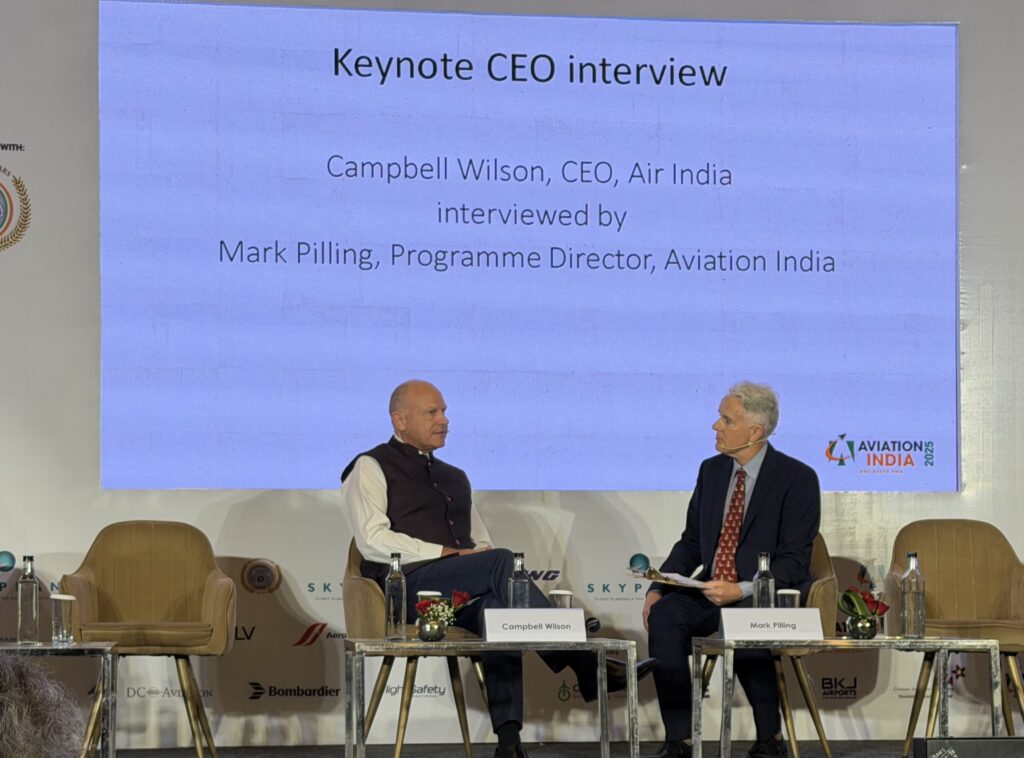
For a national carrier long known for its proud heritage and persistent operational challenges, the past twelve months have been among the most consequential in its modern history. Under the stewardship of Campbell Wilson, Air India has sought to reshape itself — not merely through shiny marketing or fleet announcements, but by confronting legacy issues on multiple fronts: safety, service, fleet and global positioning. The journey remains far from complete, but the themes of reform, introspection and ambition are now unmistakable. Wilson made his first public appearance after the events of June 2025, at Aviation India 2025, an aviation conference organised in Delhi. He also discussed the crash, the impact of the Pakistan airspace closure, and other related matters.
Safety, crisis and credibility
The most sobering event for Air India this year was the tragic crash of Flight AI171 (from Ahmedabad to London Gatwick) in June, which claimed 241 lives on board and multiple casualties on the ground. That accident, still under investigation, cast a long shadow over the transformation narrative. As Wilson acknowledged, it was “absolutely devastating … for the people, families and staff involved.”
In his public remarks, Wilson emphasised transparency and support: “We have over 600 people on the ground in Ahmedabad … We have set up a trust … providing extra share payments to all the families,” he mentioned. He added that interim compensation had been completed and final payments were in process. Notably, he noted the preliminary investigation by the Aircraft Accident Investigation Bureau (AAIB) found “nothing wrong with the aircraft, the engines, or the operation of the airline.”
Wilson’s words reflect both an acknowledgement of the gravity of the event and an effort to reassure stakeholders that operations were fundamentally sound. He said, “Anything that happens in the industry, whether that’s us or others, is a cause for introspection. … (the interim report) indicated that there was nothing wrong with aircraft engines or practices that required changing. But, of course, we’re always looking at how we can keep improving, keep getting better, and keep learning.”
For aviation professionals, the key takeaway is that Air India is publicly acknowledging the importance of safety and regulatory cooperation, even as it addresses legacy issues. For the broader public, the message is reassurance — though real credibility will turn on implementation, not just words. Also, I wish he had said a word for the family of the pilot/s, who are currently being looked at with suspicion because of the way the report was framed.
Still, Wilson pointed out that external factors added significant pressure during what he called one of the airline’s “most challenging years.” He noted that the closure of Pakistani airspace alone could cost Air India approximately INR 4,000 crore (roughly $ 450 million) in the current financial year, citing broader uncertainty in global operations.
Thus, in terms of safety and credibility, the crash was a moment of reckoning. But it also underscored how Air India’s transformation cannot be considered purely internal — broader industry disruption, geopolitical risk and aged infrastructure all play a role.
Fleet renewal, capacity and the “Climb phase”
One of the most visible pillars of Air India’s strategy is fleet expansion and modernisation. Some of the key goals that Wilson mentioned included moving from approximately 100 aircraft to a target of 300 in the near term and an ultimate aspiration of 524 total aircraft by 2031, with deliveries of “one aircraft every six days for the next three–four years.” These numbers align with Wilson’s public remarks: “The airline’s fleet has expanded from a little over 100 aircraft at the time of privatisation to 300 now, with 524 more on order. We will keep getting an aircraft about once every six days for the next three or four years.” 
However, what is coming soon is a wide-body ramp-up starting in December 2025: the first Boeing 787-9 will arrive then, followed by A350-1000s in January/February, and a legacy wide-body refurbishment comprising 26 Boeing 787s by 2027 and all Boeing 777s by early 2028. Wilson said, “By 2026, we will start ramping up the wide-body fleet and will be taking one every six weeks for two years.”
Two things stand out. The sheer scale of the orderbook and delivery cadence places Air India among the most ambitious carriers globally. Second, the refurbishment of legacy assets (rather than simply replacing them) indicates pragmatism: rather than discarding old aircraft outright, the airline is retrofitting interiors and systems to close the gap to competitors.
Wilson himself has previously framed the effort in more vivid terms. In a 2024 Business Insider interview, he said, “The gap between modern and what we offer is big, and so the urgency for us to refit these aircraft is probably greater than any other airline.”
The message here is progress: newer jets, better cabins, and an expanding network. But underlying that is a reminder that large legacy carriers cannot pivot overnight — and supply chain constraints, workforce issues, and certification delays all complicate the path.
Indeed, Wilson acknowledged supply-chain and workforce bottlenecks: “It takes about seven years to design, certify, manufacture, and install new first-class seats. And four for business class. We started that process in mid-2022, and the first refurbished wide-body will roll out in early 2026.” Although I’m sure the first aircraft to come out will be fitted with the new business cabin, rather than first-class cabins.
Thus, the fleet strategy is both aspirational and grounded: expand fast, but also upgrade properly. It signals a shift from stabilisation toward scale.
Service quality, competitive positioning and culture
Beyond steel and seats, Air India recognises that aviation is as much about service delivery as it is about hardware. The A350 product is already competitive with premium carriers such as Emirates, Singapore Airlines, and Turkish Airlines. Wilson termed it as India’s “secret sauce”: a naturally warm, hospitable culture, and that service consistency and genuine hospitality are key differentiators. Wilson has publicly affirmed service improvement efforts. In December 2024, he wrote to employees:
“…2025 will see progress on many key initiatives … further elevating Air India’s service standards, raising the bar on what we consider ‘good’, and more consistently delivering to those new expectations.”
And in a July 2025 interview, he said:
“We must take all commentary constructively with grace and an open mind and, where there is an opportunity to act, must do so.”
Although personally, I still miss this “secret sauce” on board, because most crew are noobs, and focused on getting it done, but not the hospitality part of the job.
External disruptions, competition and macro-risk
No review of Air India’s past year would be complete without acknowledging the external headwinds the airline faced. Wilson’s comments highlight this: “I think the operative word in 2025 is uncertainty. Uncertainty in global trade policy, global stability and peace, and politics. I think that does have an impact on the demand environment.”
In addition to the Pakistan airspace closure and its estimated INR 4,000 crore cost, the airline had to respond to supply chain disruptions, workforce constraints, and the persistence of pandemic-era shocks.
Bottomline
In summary, Air India’s evolution over the past year can be viewed as a balancing act between its legacy and future, between crisis response and growth, and between scale and service. Under Campbell Wilson, the carrier is repositioning itself as a global competitor grounded in Indian hospitality. The transformation has entered a phase where execution matters more than announcements.
For industry observers, the ambition is real, but so are the risks — especially those related to delivery delays, operational reliability, and external volatility. For the travelling public, the promise is improving: newer planes, upgraded interiors, more direct routes and a refreshed brand—but patience may still be required while the complex work of change takes root.
As Wilson put it, echoing the airline’s dual mandate of innovation and introspection: “We must take all commentary constructively with grace and an open mind and, where there is an opportunity to act, must do so.” With 2026 poised to be the year the “new Air India” begins to emerge visibly, the coming months will show whether the ambition meets the reality.
What do you think of the direction Air India is headed in?
Liked our articles and our efforts? Please pay an amount you are comfortable with; an amount you believe is the fair price for the content you have consumed. Please enter an amount in the box below and click on the button to pay; you can use Netbanking, Debit/Credit Cards, UPI, QR codes, or any Wallet to pay. Every contribution helps cover the cost of the content generated for your benefit.
(Important: to receive confirmation and details of your transaction, please enter a valid email address in the pop-up form that will appear after you click the ‘Pay Now’ button. For international transactions, use Paypal to process the transaction.)
We are not putting our articles behind any paywall where you are asked to pay before you read an article. We are asking you to pay after you have read the article if you are satisfied with the quality and our efforts.


Leave a Reply