

India’s two largest airlines, Air India and IndiGo, are preparing for a turbulent summer, with both carriers significantly reducing domestic operations over the coming weeks amid soaring aviation turbine fuel (ATF) prices, operational constraints, and ongoing geopolitical disruptions.
The cuts come at a time when Indian aviation was expected to see one of its strongest summer travel seasons on record. Instead, airlines are adopting capacity discipline to preserve operational reliability and money. According to reports emerging on May 27, IndiGo is expected to reduce its domestic operations by approximately 7–10% during June and July, while Air India is preparing even deeper reductions, with domestic frequency cuts approaching nearly 22% on selected routes.
Air India’s Cuts: Cost Pressure Meets Operational Reality
Air India’s reduction appears to be broader and more structural than a temporary tactical adjustment. The Tata Group-owned carrier has already been rationalising parts of its international network through August 2026, citing elevated fuel prices, airspace restrictions over parts of West Asia, and operational challenges related to fleet availability. Now, those pressures are spilling into the domestic network as well.
Air India will temporarily reduce frequencies on select domestic routes between June and August 2026. The airline has publicly attributed the move to rising fuel costs and operational constraints, while emphasising that affected passengers will be accommodated with alternative flights, complimentary date changes, or refunds.
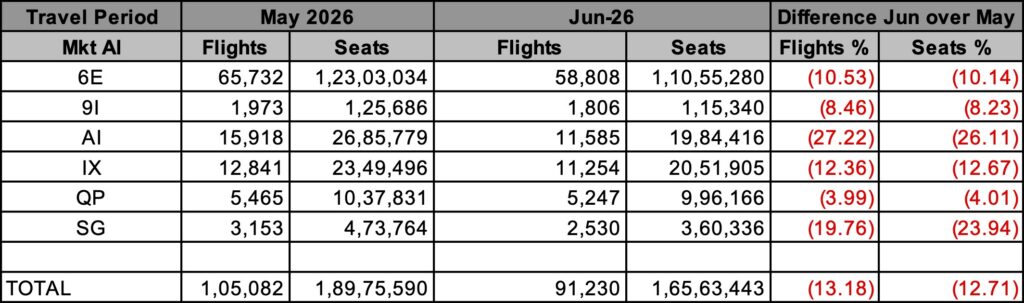
I compiled data on the number of domestic flights scheduled in May 2026 vs June 2026 with data available from Cirium, and this is what it showed. Air India is reducing its domestic schedule from 15,900 flights in May 2026 to 11,600 in June 2026. That is a 27% reduction in the number of flights in a month.
The backdrop is important here. Air India has been dealing simultaneously with:
- Rising ATF prices linked to the ongoing West Asia conflict,
- Longer flight times caused by airspace restrictions,
- Continuing enhanced safety inspections,
- Aircraft availability issues (such as aircraft away for retrofits or engineering checks, and so on)
- And the challenge of maintaining schedule integrity across a rapidly expanding network.
Air India issued a statement via a spokesperson and said,
In continuation of our previously announced adjustments to select international services between June and August 2026, we have temporarily rationalised operations on certain domestic routes during the same period, with a reduction in frequencies on select routes. These adjustments are driven by the sustained impact of high fuel prices on overall operations. Air India will continue to monitor demand and operating conditions closely, with a view to restoring frequencies as conditions stabilise. Passengers impacted by these changes will be proactively assisted with re-accommodation on alternative flights, complimentary date changes, or full refunds, as applicable.
For Air India, some flights were also operated to offer connections from International flights arriving or departing from India. That goes away for the time being as well because the international flights are also going through cutbacks for now.
IndiGo’s Capacity Discipline Continues
For IndiGo, the domestic cuts are part of a broader operational recalibration that has been building for months. India’s largest airline has faced recurring challenges linked to aircraft availability, engine maintenance bottlenecks, airport congestion, and cascading operational delays.
Earlier this year, aviation regulators had already reduced IndiGo’s approved schedules after widespread disruptions and cancellations affected passengers across the country. IndiGo currently has an approved schedule to operate 1950 daily flights. The DGCA had moved to align IndiGo’s schedule with its actual operational capability after a difficult winter period marked by delays and cancellations.
The current round of reductions, however, appears to be driven more by economics than by regulation. Since fuel can account for up to 40% of airline operating expenses, airlines are increasingly unwilling to operate marginal or low-yield routes at current cost levels.
Data from Cirium again show a similar trend: deep cuts in the domestic network. The airline has cut its schedule by 11% between May and June 2026, which means flights scheduled go down from 65,732 in May 2026 to 58,808 in June 2026.
IndiGo has also previously acknowledged that airspace restrictions, longer flight times, and airport congestion were affecting operational reliability.
The Bigger Story: Indian Aviation’s Growth Is cutting schedules across the board in peak summer schedules.
What is happening right now goes beyond temporary summer cuts. India’s aviation market continues to grow rapidly, but the ecosystem around it remains under immense strain.
The country saw approximately 2,600 fewer domestic flights in May 2026 than in May 2025. There are cuts across the board for domestic flights for the six airlines that file their data with data suppliers such as Cirium. This even includes government-owned Alliance Air. The biggest dip in scheduled flying cuts is with Air India, while SpiceJet is cutting about 20% of their flights (which is not a bad thing, because lesser people stranded at airports after booking a ticket with them)
All of this because,
- Aircraft shortages remain a global problem,
- Engine maintenance queues continue to affect airlines worldwide,
- Airspace closures are forcing longer routings,
- Major Indian airports remain congested,
- Fuel prices have become deeply volatile.
The result is that airlines are increasingly prioritising operational resilience over maximum utilisation. This marks a departure from the earlier “grow at all costs” mentality that defined Indian aviation over the past decade, even for airlines with smaller market shares, which are more focused on protecting their balance sheets than on protecting their market share at this point.
What This Means for Passengers
For travellers, the impact will likely become visible quickly over the coming weeks. You should expect Fewer frequencies on key metro routes, Reduced flexibility for same-day travel, higher fares during peak periods, Greater reliance on redeployments and aircraft substitutions, and tighter seat availability on weekends and holidays.
For instance, Delhi – Mumbai saw 3,791 flights scheduled amongst 5 major carriers in the month of May 2026, and this will go down to 3,200 flights in June 2026, with Air India (which was the market leader on the route), cutting from 27-28 daily flights to 20-21 daily flights, so about 7 flights evaporate temporarily.
Passengers booked on affected flights are expected to receive rebooking or refund options, though the scale of schedule adjustments could still create operational friction during the busy summer period.
For Air India specifically, the cuts also represent an important test. The airline is in the midst of one of the largest transformation exercises in global aviation, but its ability to stabilise operations amid fuel shocks, geopolitical disruptions, and fleet constraints will determine how quickly it can regain passenger confidence at scale.
The coming months may therefore define whether India’s aviation sector can transition from hyper-growth to sustainable growth — without sacrificing reliability in the process.
Bottomline
There are cutbacks on routes across the board for domestic airlines, with all sorts of operations being scaled back, largely between June 2026 and August 2026 for the time being. 13% of flights are being cut across airlines domestically, with Air India leading the charge with over 20% of flights being cut for the airline in the coming months (domestically).
What do you make of the cuts across the board for airlines of India?
Liked our articles and our efforts? Please pay an amount you are comfortable with; an amount you believe is the fair price for the content you have consumed. Please enter an amount in the box below and click on the button to pay; you can use Netbanking, Debit/Credit Cards, UPI, QR codes, or any Wallet to pay. Every contribution helps cover the cost of the content generated for your benefit.
(Important: to receive confirmation and details of your transaction, please enter a valid email address in the pop-up form that will appear after you click the ‘Pay Now’ button. For international transactions, use Paypal to process the transaction.)
We are not putting our articles behind any paywall where you are asked to pay before you read an article. We are asking you to pay after you have read the article if you are satisfied with the quality and our efforts.


Leave a Reply