

Earlier this week, IndiGo flight 6E2142, operated by an Airbus A321neo between Delhi and Srinagar, found itself in the throes of severe weather that caused visible structural damage to the aircraft. The nose cone was heavily dented following an encounter with a hailstorm while descending into Srinagar. Despite the circumstances, the crew managed to bring the aircraft in for a safe landing, averting any serious aviation incident.
Into the Eye of the Storm
The pilots asked for deviation from the filed path from the IAF Northern Control when they neared this weather system near Pathankot. Their request was denied. They then tried their luck for an even further left by asking Pakistan’s Lahore ATC for an entry into their airspace to navigate the weather (and then reenter Indian airspace). Since Pakistan Airspace is closed to Indian aircraft, even that request was denied.
According to preliminary information from aviation authorities, the flight was cruising at FL360 when it inadvertently entered a cumulonimbus system. Within moments, the autopilot disconnected as the aircraft faced a sudden loss of stability caused by turbulence and hail. The aircraft hit its maximum operating speed, prompting the crew to take manual control and initiate a rapid descent to exit the unstable weather zone.
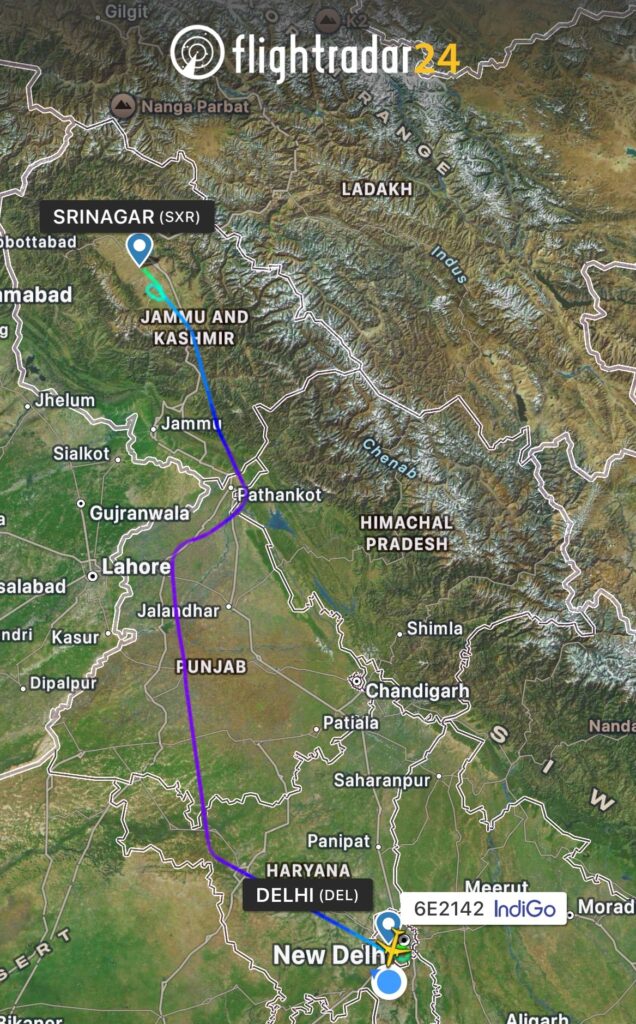
Flightpath of 6E2142 (via FlightRadar24)
Crew initially attempted to return back but as they were close to the thunderstorm cloud, they decided to penetrate the weather. Subsequently, they encountered a hailstorm and severe turbulence. The crew chose to continue at the same heading to exit the weather by the shortest route towards Srinagar.
While in the thunderstorm cloud, warnings of Angle of Attack fault, Alternate Law protection lost, and backup Speed scale unreliable were triggered. Due to updraft and downdraft encountered by the aircraft, the Autopilot tripped, and the aircraft’s speed had wide variations. As a result, Maximum Operating Speed/Maximum operating Mach (VMO/MMO) warnings and repeated stall warnings were triggered. During this period, the aircraft’s rate of descent reached 8500 fpm. The crew flew the aircraft manually till they exited the hailstorm. After carrying out all checklist actions (ECAM actions), the crew declared PAN PAN to Srinagar ATC and requested RADAR vectors and made a safe landing with Auto Thrust operating normally.
The windshield wipers engaged automatically due to heavy precipitation, and the aircraft endured repeated hail impacts. The radome—the aircraft’s nose cone—took substantial damage, bearing the brunt of the storm.
After the Landing: A Closer Look
Post-landing visuals of the aircraft clearly showed the extent of the damage to the nose cone, which appeared crumpled and shredded. The aircraft was immediately grounded in Srinagar for inspection and repairs. It has still not operated a flight since the incident.
The Directorate General of Civil Aviation (DGCA) is reviewing data from the aircraft’s flight data recorder (FDR) and cockpit voice recorder (CVR) as part of its investigation. Here is the statement from the DGCA.

Bottomline
This mid-air episode underscores the unpredictable nature of weather and the critical role of skilled crew response. IndiGo 6E2142’s safe arrival in Srinagar despite hail, turbulence, and a rapid descent is a testament to the crew’s training and professionalism. For passengers, it’s a compelling reminder of why that seatbelt sign matters—and why we trust trained professionals in the cockpit.
What do you make of this IndiGo event and the outcome?
Liked our articles and our efforts? Please pay an amount you are comfortable with; an amount you believe is the fair price for the content you have consumed. Please enter an amount in the box below and click on the button to pay; you can use Netbanking, Debit/Credit Cards, UPI, QR codes, or any Wallet to pay. Every contribution helps cover the cost of the content generated for your benefit.
(Important: to receive confirmation and details of your transaction, please enter a valid email address in the pop-up form that will appear after you click the ‘Pay Now’ button. For international transactions, use Paypal to process the transaction.)
We are not putting our articles behind any paywall where you are asked to pay before you read an article. We are asking you to pay after you have read the article if you are satisfied with the quality and our efforts.


The bottom line is that this incident may not have happened or been as risky if they had prioritized civilian air traffic being rerouted instead of catering to the Air Force and other military demands during severe inclement weather.
And it’s a reminder of why flying into SXR is extra risky nowadays.
If airplane was shot down from either sides like malaysian airlines question would be asked who let airplane into active warzone.
Airplane should have turned back but maybe pilot has reason for their decision that we don’t know
The cockpit crew asked to be rerouted away but were denied their requests by air traffic control. So the pilot could either stick to what ATC told them to do or end up at risk of being considered a renegade plane or threat by the government/military. Basically, the government forced the plane to stick to the original flight plan when the flight crew wanted an urgent escape from being made to go on to SXR.
Multiple stall warnings is frightening