

Air India has launched one of the most significant structural changes to international air travel from India. The airline announced Easy Connect flights earlier in June 2026 and today launched its first Easy Connect flight from Varanasi, operationalising the Government of India’s new hub-and-spoke international transfer framework, which allows passengers to complete immigration and baggage formalities at their origin airport before connecting onward through Delhi (or Mumbai, shortly).
The first Easy Connect flight has flown.
The inaugural Easy Connect service, AI1111, departed Varanasi this morning with passengers travelling onwards via Delhi to international destinations including Dubai, Colombo, Jeddah, Riyadh, Kathmandu and Phuket. While those were among the first onward connections, the schedule actually allows connections to 17 international destinations within four hours of arrival in Delhi, including London, Frankfurt, Zurich, Rome and Milan.
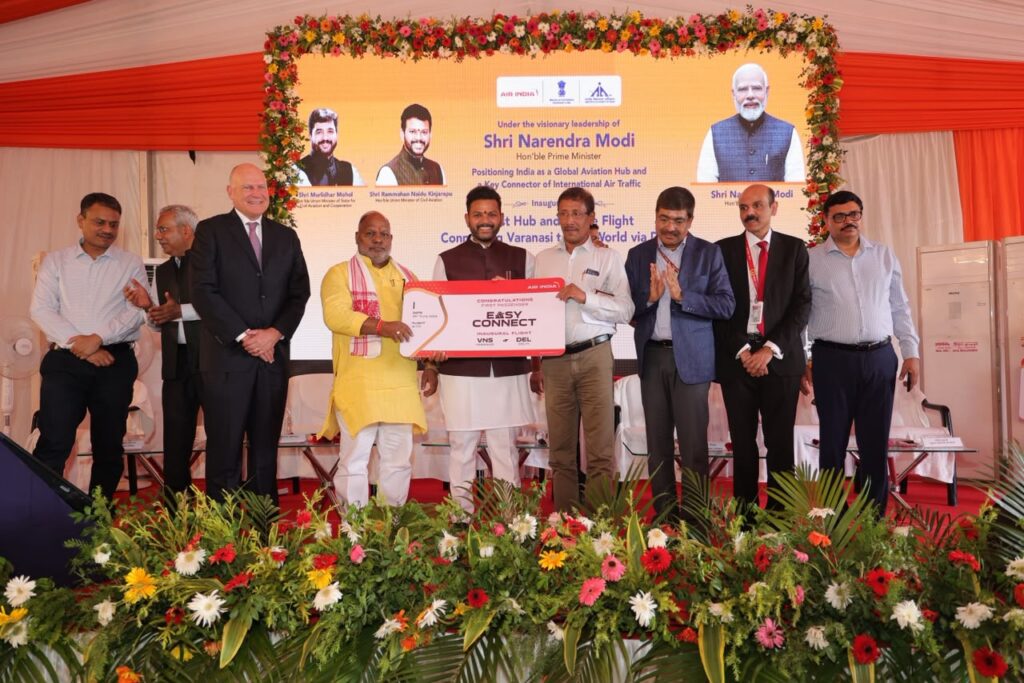
The service was inaugurated in Varanasi by Civil Aviation Minister Kinjarapu Ram Mohan Naidu, alongside Air India CEO & MD Campbell Wilson, Mr P. Balaji, Group Head – Governance, Risk, Compliance & Corporate Affairs, Air India and senior officials from the Ministry of Civil Aviation, the Airports Authority of India, and Air India.
Easy Connect attempts to simplify the complicated transit to travel outside of India from the interior airports inside India
For passengers, however, the real significance lies in what happens before they board. Instead of flying to Delhi as a domestic passenger, collecting baggage, changing terminals where required, checking in again and clearing immigration before boarding an international flight, Easy Connect effectively treats the journey as a single international itinerary from the moment passengers arrive at their hometown airport.
Passengers departing from participating cities will:
- receive boarding passes through to their final destination;
- Check their baggage all the way through;
- complete immigration at their departure airport rather than at Delhi; and
- remain airside during the transfer at the hub airport without re-checking baggage.
What Air India and the Indian Ministry of Civil Aviation aim to achieve is a journey without the need to collect bags, process immigration at the second airport, or go through security checks repeatedly. The concept is simple but could be transformative. For Indian travellers who have traditionally preferred connecting through Gulf hubs for smoother transfer experiences, this aims to create a comparable experience entirely within India.
The programme also supports the Government’s broader ambition to develop Indian airports into global connecting hubs, rather than allowing millions of passengers to transit through Dubai, Doha, Abu Dhabi, Singapore or Istanbul every year.
According to Air India, nearly 25 million passengers travel long-haul to and from India annually. Around 20 million of them are connecting passengers, and approximately 17 million currently connect through overseas hubs rather than Indian airports.
Expansion will come quickly
While Varanasi is the first city to go live, Air India has already confirmed that the rollout will expand rapidly. The airline says Easy Connect services will progressively be introduced from:
- Ahmedabad
- Amritsar
- Chennai
- Goa
- Guwahati
- Hyderabad
- Kochi
- Mumbai
- Patna
- Vadodara
- Visakhapatnam
The Civil Aviation Minister indicated that the next phase may happen even faster than originally anticipated, stating that flights from six more cities are expected to begin within the next six weeks as the hub-and-spoke model gathers momentum. That suggests passengers will not have to wait very long before the network begins expanding across the country.
There are still a few conditions, though. Easy Connect is not yet identical to a conventional international departure.
Passengers must satisfy several operational requirements, including mandatory DigiYatra enrolment for eligible Indian passport holders. Boarding passes need to be uploaded into the DigiYatra application before departure, while web check-in is currently unavailable from the spoke airports. Customs declarations also cannot presently be completed there. These are largely procedural issues and are likely to evolve as the system matures.
Why this matters
Easy Connect is much more than a new flight number. For years, one of the biggest disadvantages Indian airlines faced compared with Gulf carriers was that passengers from Tier II and Tier III cities often found it easier to connect through Dubai, Doha, or Abu Dhabi than through an Indian metro airport. Multiple security checks, baggage uncertainty, immigration queues and tight transfers all made domestic hub connections less attractive.
The new framework removes many of those pain points by allowing passengers to begin their international journey at their home airport, much as travellers do when connecting through mature international hubs elsewhere in the world.
For Air India, this is equally important.
As the airline rebuilds its long-haul network, success increasingly depends on feeding more passengers into Delhi, Mumbai and Bengaluru rather than relying solely on local traffic originating in those cities. Easy Connect gives Air India an important tool to strengthen that strategy while making Indian hubs more competitive against overseas gateways.
The concept will also become more powerful as Air India expands its international network and receives additional long-haul aircraft over the coming years.
Bottomline
Air India’s Easy Connect flights have become a reality, with the inaugural service operating from Varanasi today. The launch marks the operational beginning of India’s new international hub-and-spoke model, allowing passengers to check in, clear immigration and transfer seamlessly through Delhi without repeating airport formalities.
With another eleven cities already identified for rollout, and the Civil Aviation Minister indicating that six additional cities could come online within the next six weeks, the programme is moving quickly from pilot project to nationwide initiative. If execution matches ambition, Easy Connect could become one of the most significant improvements to international air travel from non-metro India in recent years, alongside the reduction of paperwork and the FTI-TTP launched recently.
I took the first flight out, and more on that in an upcoming post.
What do you think of transiting through Delhi, now that Easy Connect is an Option?
Liked our articles and our efforts? Please pay an amount you are comfortable with; an amount you believe is the fair price for the content you have consumed. Please enter an amount in the box below and click on the button to pay; you can use Netbanking, Debit/Credit Cards, UPI, QR codes, or any Wallet to pay. Every contribution helps cover the cost of the content generated for your benefit.
(Important: to receive confirmation and details of your transaction, please enter a valid email address in the pop-up form that will appear after you click the ‘Pay Now’ button. For international transactions, use Paypal to process the transaction.)
We are not putting our articles behind any paywall where you are asked to pay before you read an article. We are asking you to pay after you have read the article if you are satisfied with the quality and our efforts.


Leave a Reply