

A few days ago, we reported that Air India is deliberating on launching Basic Fares, which would cut back meals on certain routes when customers buy the basic fare. Last night, these fares were made available for booking on a trial basis.
Air India’s new “Basic” fare category is available on select domestic routes, marking one of the most significant changes to its domestic Economy Class proposition in recent years. For the first time in its modern history, the airline will offer a domestic fare without complimentary meals, bringing it closer to the unbundled pricing model that has become common across the aviation industry.
The new fare category is being positioned as an option for price-conscious travellers who are willing to forgo certain inclusions in exchange for a lower ticket price. Air India says the fare is currently being introduced on select domestic sectors and is designed to provide customers with greater choice rather than replace its existing fare structure. Air India last updated its fare families in 2023.
What does Air India’s Basic Fare include?
Under the new Basic fare, passengers will continue to receive a 15-kilogramme checked baggage allowance and a 7-kilogramme cabin baggage allowance. However, complimentary meals will no longer be included in the ticket price. Travellers who wish to eat onboard can purchase meals separately, either in advance or via available ancillary options. Here is an instance
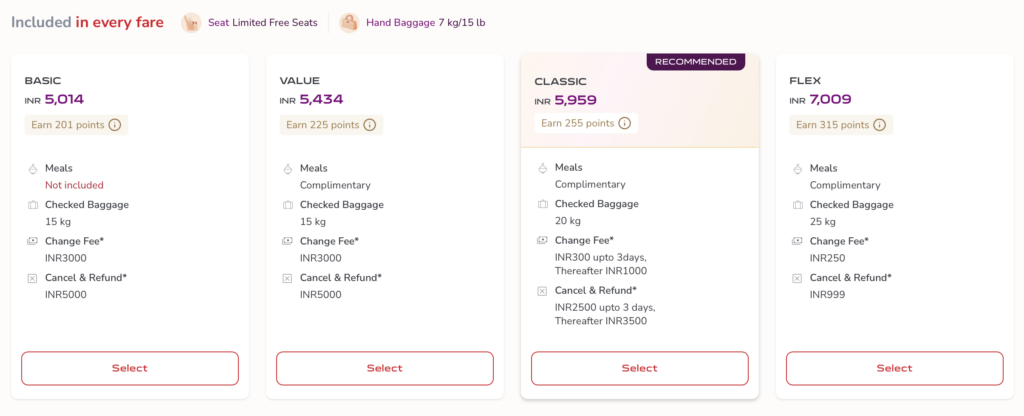
Importantly, Air India is not eliminating its existing fare families. The airline’s Value, Classic and Flex fare categories remain available and continue to include complimentary hot meals as part of the ticket price. The difference between the Basic and Value fares is largely INR 300-500, which is the cost of a sandwich meal or a full tray of hot food.
The move effectively adds a fourth fare bucket at the bottom of the pricing ladder, allowing Air India to display a lower headline fare while giving passengers the option to pay only for the services they need.
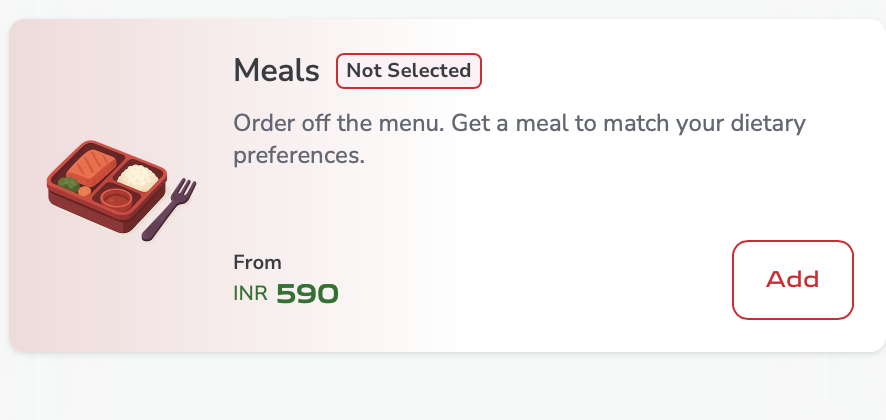
The flow gives ample opportunities to upsell or change your mind. If you pick this fare and later want a meal, you can still get one, but for INR 590.
Why is Air India doing this?
The introduction of Basic fares comes at a time when Air India continues to grapple with elevated operating costs, record fuel prices and the financial pressures associated with its ongoing transformation programme.
Air India has framed the decision as a customer-choice initiative, but the economics are hard to ignore. Catering remains a meaningful cost item, especially on shorter domestic sectors where many passengers either skip meals entirely or purchase tickets primarily on price. By unbundling food from the cheapest fares, Air India can both reduce catering expenses and better compete with low-cost carriers, whose fares often appear lower because ancillary services are sold separately.
A move towards industry norms
From an industry perspective, Air India was increasingly becoming an outlier.
Most carriers in India, including IndiGo, Akasa Air and Air India Express, operate on an ancillary-led model where meals are generally sold separately. Air India, meanwhile, continued to offer complimentary meals even on short domestic sectors, reinforcing its positioning as a full-service carrier.
The introduction of Basic fares does not mean Air India is abandoning that full-service positioning altogether. Instead, it is adopting a hybrid approach similar to that used by many network carriers worldwide. Airlines such as Lufthansa, British Airways and Air Canada offer stripped-down Economy fares while preserving a more inclusive experience for passengers willing to pay more.
For Air India, this creates an opportunity to participate more aggressively in fare comparisons without forcing every passenger to subsidise services they may not use. But for this approach to work, they will have to publish these fares on OTAs as well, which is not the case at the moment. Perhaps because it is an experiment for now.
What should passengers expect?
The biggest question now is pricing. For the time being, I’ve noted that various routes are cheaper by INR 300-500. The success of the initiative will likely depend on whether passengers see a meaningful fare difference. If the savings are only a few hundred rupees, many travellers may still prefer the fare that includes meals, making this an upselling initiative and a lever to make the next fare level the one people book (Value Fares).
It will also be interesting to see whether the airline expands the concept beyond the initial pilot routes. The rollout is being monitored before a wider implementation decision is taken.
For frequent flyers, corporate travellers and those connecting from international flights, the change is unlikely to have a major impact, since higher fare categories will continue to include meals and other benefits. The target audience is clearly the leisure traveller who shops primarily on price.
Bottomline
Air India has introduced a new Basic fare category on select domestic routes, removing complimentary meals while retaining standard baggage allowances. The move gives the airline a lower entry-level fare to compete with low-cost carriers and reflects a broader trend towards unbundling airline services. While Air India is presenting the change as an expansion of customer choice, it is equally a reflection of the cost pressures facing airlines today. The key determinant of success will be whether the price gap between Basic and traditional fares is large enough for passengers to see real value in giving up their free meal.
What do you think of Air India offering no-meal fares?
Liked our articles and our efforts? Please pay an amount you are comfortable with; an amount you believe is the fair price for the content you have consumed. Please enter an amount in the box below and click on the button to pay; you can use Netbanking, Debit/Credit Cards, UPI, QR codes, or any Wallet to pay. Every contribution helps cover the cost of the content generated for your benefit.
(Important: to receive confirmation and details of your transaction, please enter a valid email address in the pop-up form that will appear after you click the ‘Pay Now’ button. For international transactions, use Paypal to process the transaction.)
We are not putting our articles behind any paywall where you are asked to pay before you read an article. We are asking you to pay after you have read the article if you are satisfied with the quality and our efforts.


Jetlite redux.
What’s with the slop thumbnail?
@B-LRQ, easier to make than a real one.
Good initiative, even though it’s driven by the need for cost-cutting.
As you mentioned, many travelers on Corporate fares or International connections will not be affected. Also, many passengers will take the meal on ground – at the lounge or airport concessions.
But the big issue is that these fares must be marked clearly as such on OTAs as and when they are exposed on the platforms.
Otherwise, unwitting pax who are infrequent travelers will book Basic Fares only with AI’s Full service reputation in mind and get a negative surprise.
Perhaps, this is why the airline is currently offering it only on their channels?