

IndiGo has offered its clearest indication yet of how it plans to deploy its future Airbus A350-900 fleet, revealing during its Investor Day 2026 presentation that its long-haul flagship aircraft will be configured with 330 seats.
While that number may not sound remarkable, it offers an insight into how India’s largest airline is thinking about its future. IndiGo appears to be opting for a configuration that balances efficiency with passenger comfort and premium revenue opportunities.
For an airline that built its success on a low-cost, single-class model, the A350 programme increasingly looks like the vehicle that will transform IndiGo into a genuine global network carrier.
A fleet of 60 A350s, and counting
IndiGo’s widebody ambitions are no longer a small experiment. The airline first ordered 30 Airbus A350-900 aircraft in 2024, marking its entry into the long-haul widebody segment. In 2025, it firmed up an additional order for 30 Airbus A350-900s, bringing its total commitment to 60. The airline also retains purchase rights for an additional 40 aircraft.

IndiGo’s order for 30 A350-900 aircraft (Image via Airbus)
The first deliveries are expected from 2027 onwards, giving IndiGo the capability to launch nonstop services far beyond the reach of its existing narrowbody fleet.
The order book is significant not just for its size, but also because it signals that IndiGo sees widebody operations as a core part of its future business model rather than a niche addition.
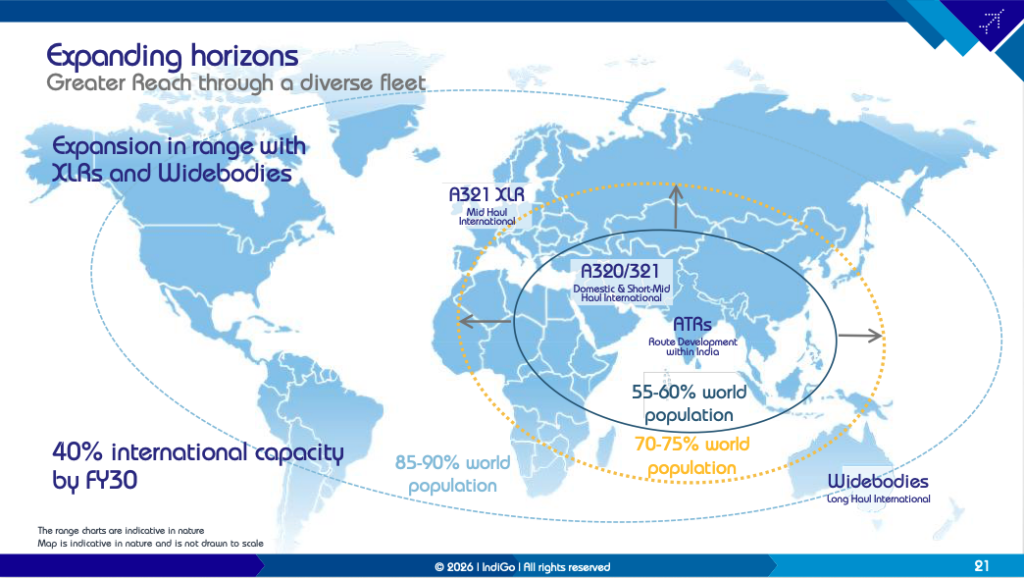
Slide from IndiGo’s Analyst Day Presentation, 2026
One of the newer disclosures that has come to light from IndiGo’s presentation today has been that IndiGo’s A350s will be configured with over 330 seats. This is the first piece of information they have given the public and analysts about their product definition.
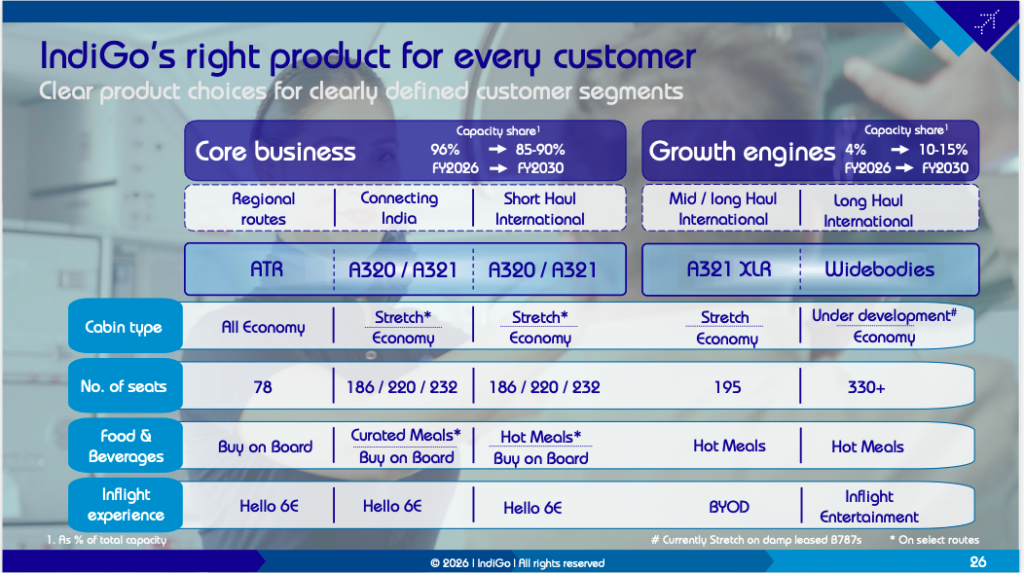
Why do 330+ seats matter?
The Airbus A350-900 is typically configured by airlines with 300-350 seats in a standard three-class layout, although the aircraft can accommodate substantially more passengers in high-density configurations. That makes IndiGo’s planned 330+ seat configuration particularly interesting.
There are two clues already out there, then. First, there will be a premium cabin, and second, there will be an economy cabin. I fully expect a new custom take on an existing product to make the front cabin work. It most likely won’t be called “Business Class”, but something else, and will ideally come with the ability to go fully flat, perhaps since one won’t want to pay premium prices and yet be in a zone where they cannot go horizontal while sleeping. And Angular Flat is so last generation that I don’t think anyone is developing it anymore.
What I’m thinking is that there will be a 30-40-seat business-class cabin with a 44″ Seat Pitch and a 290-300-seat economy-class cabin with a 31″ -32 ” seat pitch. There could also be two versions, with one having fewer business-class seats to accommodate more business-class seats. And because there is absolutely no way to offer long-haul entertainment with Bring Your Own Device, IndiGo will finally get in-seat back entertainment as well.
Many expected the airline to push the aircraft towards the higher end of the seating spectrum in keeping with its low-cost roots. Instead, the disclosed seat count suggests IndiGo is reserving a meaningful amount of cabin space for premium products and passenger comfort.
Over the past year, the airline has introduced IndiGo Stretch, launched business-class style seating on domestic routes, and begun operating long-haul flights using wet-leased Boeing 787 aircraft. The A350 appears set to become the natural extension of that premiumisation strategy.
Beyond Europe: The next frontier
The A350 will dramatically expand the airline’s reach.
Today, IndiGo’s international network is largely built around narrowbody operations and medium-haul destinations. The airline has started testing long-haul markets using leased Boeing 787 aircraft, including services to Europe, but its own A350 fleet will provide the scale and flexibility required for sustained long-haul growth.
The aircraft’s range opens the door to nonstop services from India to destinations across Europe, East Asia, Australia and eventually North America.
This is consistent with IndiGo’s vision of becoming a global aviation player by the end of the decade. Airbus itself has described the A350 order as a key element of IndiGo’s strategy to expand its international footprint and connect India to more destinations worldwide.
The battle for India’s long-haul traveller
The timing of the A350 expansion is no coincidence.
India remains one of the world’s fastest-growing aviation markets, but a significant share of long-haul international traffic still flows through foreign hubs in the Gulf, Europe and Southeast Asia. Both IndiGo and Air India are now investing heavily in widebody fleets to capture more of that traffic directly.
For IndiGo, the challenge will be balancing its low-cost DNA with the expectations of long-haul premium travellers.
The disclosed 330-seat configuration suggests the airline is taking a measured approach. Rather than maximising capacity, it appears willing to sacrifice some seats in favour of a product that can compete more effectively on routes lasting eight, ten or even fifteen hours.
Bottomline
The most interesting takeaway from IndiGo’s Investor Day presentation was not the size of its A350 order book. Instead, it was the revelation that the A350-900 will carry 330+ passengers. IndiGo will also keep operations two-class only, from the looks of it, with a business cabin it will call something else and an economy cabin. So no sign of an in-between Premium Economy cabin, but perhaps it might have an Economy+ Cabin (XL seats).
What do you think of IndiGo’s long-haul configurations?
Liked our articles and our efforts? Please pay an amount you are comfortable with; an amount you believe is the fair price for the content you have consumed. Please enter an amount in the box below and click on the button to pay; you can use Netbanking, Debit/Credit Cards, UPI, QR codes, or any Wallet to pay. Every contribution helps cover the cost of the content generated for your benefit.
(Important: to receive confirmation and details of your transaction, please enter a valid email address in the pop-up form that will appear after you click the ‘Pay Now’ button. For international transactions, use Paypal to process the transaction.)
We are not putting our articles behind any paywall where you are asked to pay before you read an article. We are asking you to pay after you have read the article if you are satisfied with the quality and our efforts.


Leave a Reply