

In a major immigration reform announced in late September 2025, India’s Home Ministry confirmed that paper disembarkation (arrival) cards will be discontinued for all foreigners from October 1, 2025. Under the new rule, incoming travellers will submit an e-Arrival Card (online) instead of filling out a physical form at the airport.
India transitions from Physical Arrival Cards to E-arrival Cards effective October 1, 2025
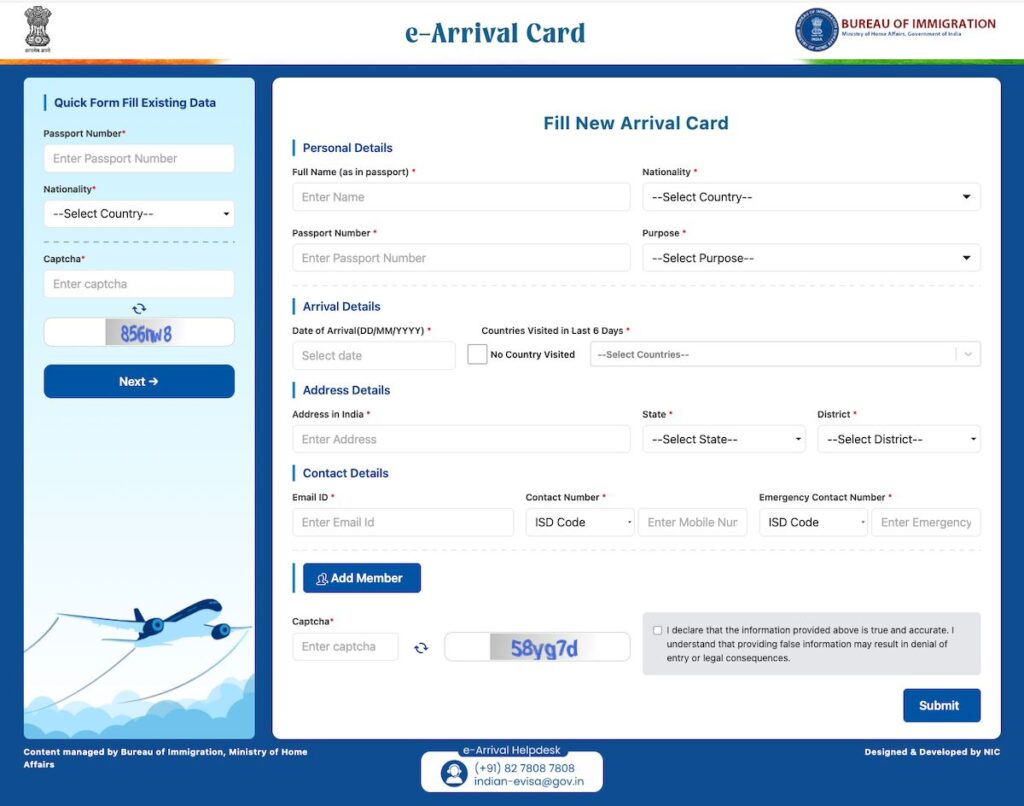
As the government explained, this change will “smooth” the immigration process and “avoid delays” by moving the arrival card online, a long-standing request from many people. After all, the information submitted is not actionable; it is merely for archival purposes until it is actually needed to locate someone. The form to be filled in is hosted at the URL: https://indianvisaonline.gov.in/earrival/ and must be completed within 72 hours before arrival.
All foreign nationals entering India will be covered – whether visiting on tourist, business, student, medical, conference, or research visas, or other categories. Indian passport holders continue to be exempt, as they already use separate clearance lanes. Here is the notification from the Ministry of Home Affairs.
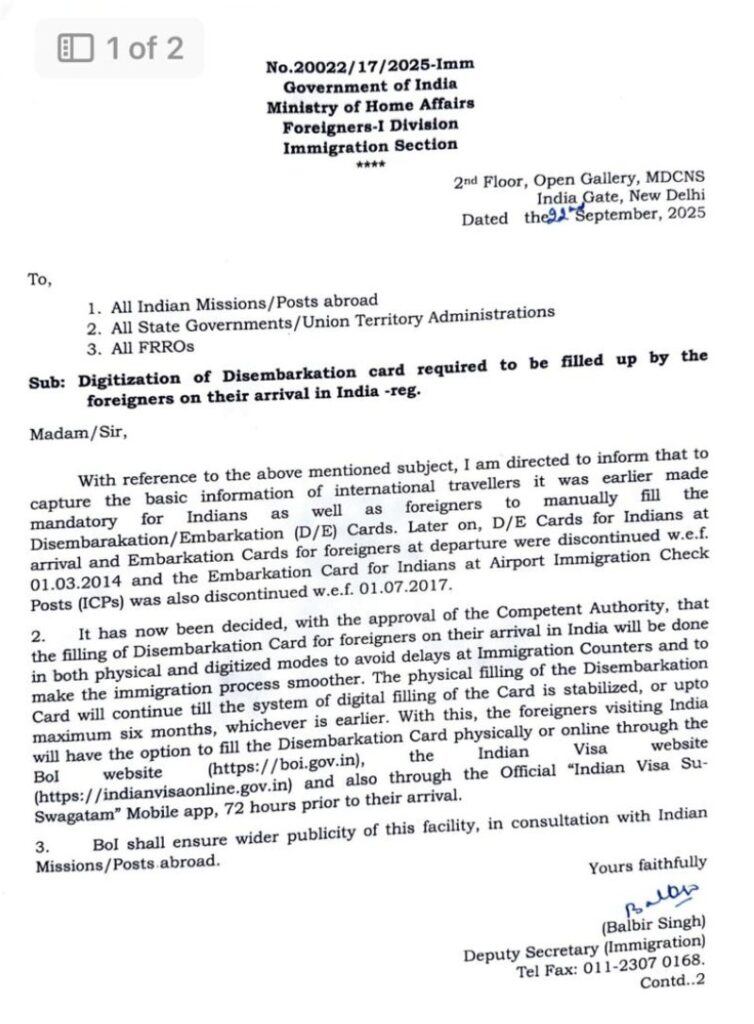
Importantly, Indian authorities plan a transition phase to facilitate a smooth switch. Paper cards will be phased out gradually. For the first six months, physical forms will still be accepted; however, visitors are encouraged to use the online system for faster processing. After this overlap period, the paper option will be withdrawn entirely. During the transition, however, the e-Arrival Card is being made easily accessible.
Who Must Use the E-Arrival Card
According to official advisories, every foreign traveller – regardless of visa type – will now fill out their arrival information electronically. The official website even lists examples: tourists, business travellers, students, medical patients, and conference attendees are explicitly covered. In short, virtually all non-Indian visitors who previously had to handwrite a disembarkation card on landing will now use the e-Arrival Card. The new rule thus applies to all individuals, including those with e-visas, visas on arrival, and regular visas, alike; it is not limited to any single category. (Exceptions remain only for Indian citizens)
How the E-Arrival System Works
Under the new system, travellers are expected to submit their arrival details online before travelling. The e-Arrival Card can be completed up to three days (72 hours) before the flight. Passengers log on to the official Bureau of Immigration portal (the e-Visa site) or use the Indian Visa Su-Swagatam mobile app (or participating airport websites) and enter the same information that was previously requested on paper. This includes passport and visa data, date of arrival, purpose of visit (tourism, business, study, medical/Ayush treatment, employment, etc.), local address, contact details, and emergency contact. Once submitted, the system generates a confirmation or “preview” of the e-Arrival Card, which the traveller can save or print. This digital record (often a QR code or reference number) is what immigration officers will use to verify the traveller’s information on arrival. In practice, visitors should proceed to the immigration counter as usual; in theory, no additional step is needed at the airport, since their data are already in the system.
Changes at Immigration Counters
The abolition of paper forms brings clear operational changes at airports. Immigration officials will no longer hand out blank disembarkation cards or wait for passengers to complete them. Instead, officers will have travellers’ details pre-loaded electronically. The press release from Delhi’s airport operator (DIAL) notes that the new system “eliminates the need for manual, paper-based cards at the airport”. In other words, the step of handing out and processing a paper form disappears.
Bottomline
If you are a foreign national arriving in India as of October 1, 2025, you will be exempt from completing the paper arrival form. The new e-arrival website is now live, and you must complete the form within 72 hours. Indians have long been exempt from this requirement; therefore, this is only applicable to individuals travelling to India without Indian passports .
What do you make of the new move to kill the physical arrival form?
Liked our articles and our efforts? Please pay an amount you are comfortable with; an amount you believe is the fair price for the content you have consumed. Please enter an amount in the box below and click on the button to pay; you can use Netbanking, Debit/Credit Cards, UPI, QR codes, or any Wallet to pay. Every contribution helps cover the cost of the content generated for your benefit.
(Important: to receive confirmation and details of your transaction, please enter a valid email address in the pop-up form that will appear after you click the ‘Pay Now’ button. For international transactions, use Paypal to process the transaction.)
We are not putting our articles behind any paywall where you are asked to pay before you read an article. We are asking you to pay after you have read the article if you are satisfied with the quality and our efforts.


I wish OCIs were clearly mentioned one way or the other in the memo. Or that there was an official website with the new info with FAQs. Right now it’s just a bunch of social media postings by various Indian Consulates and High Commissions around the world, and various news articles are claiming OCIs are exempt. But the memo does not mention OCIs specifically so we can assume India treats them as foreigners in this regard (and if that’s the case, there should be an option in the ‘reason for visit’ of ‘OCI,’ as they may live in India and are not ‘visiting’ for tourism or medical and the like). So far with no official web page with the announcement, it seems the memo is all we can go by, because the official e-Arrival card website does not mention OCIs either, or really have any other info other than the information input page.
Using the physical arrival form was always an extremely backward approach to entry when several other countries have progressed into paperless/passportless formats including facial recognition. I have always been baffled by this dystopian absurdity.
And is it India provides the world with IT HR fodder..?
India needs to take care, upgrade and improve it’s own ‘backyard’ capability… but they’re still generations behind…
I’m surprised to read about the exemption for OCI holders, because as an OCI holder I have always had to fill the physical card and submit it at immigration, as recent as two weeks ago.
Regardless, digitalizing this process is a welcome move for sure.
@Akshay, I’m surprised as much. However, since I read some paperwork that suggested otherwise, I thought perhaps the GoI knew better. Will fix it