

After years of planning, construction delays and anticipation, Noida International Airport (NIA) at Jewar has finally commenced commercial operations, marking one of the most significant developments in Indian aviation in recent years.
On June 15, 2026, IndiGo became the first airline to operate commercial flights to and from the airport, with the inaugural arrival from Lucknow touching down in the morning, followed shortly by the first departure to Bengaluru (which was actually beaten by the first departure to Lucknow). The launch officially gives the National Capital Region (NCR) its second major full-service commercial airport and introduces a new aviation gateway for Western Uttar Pradesh.
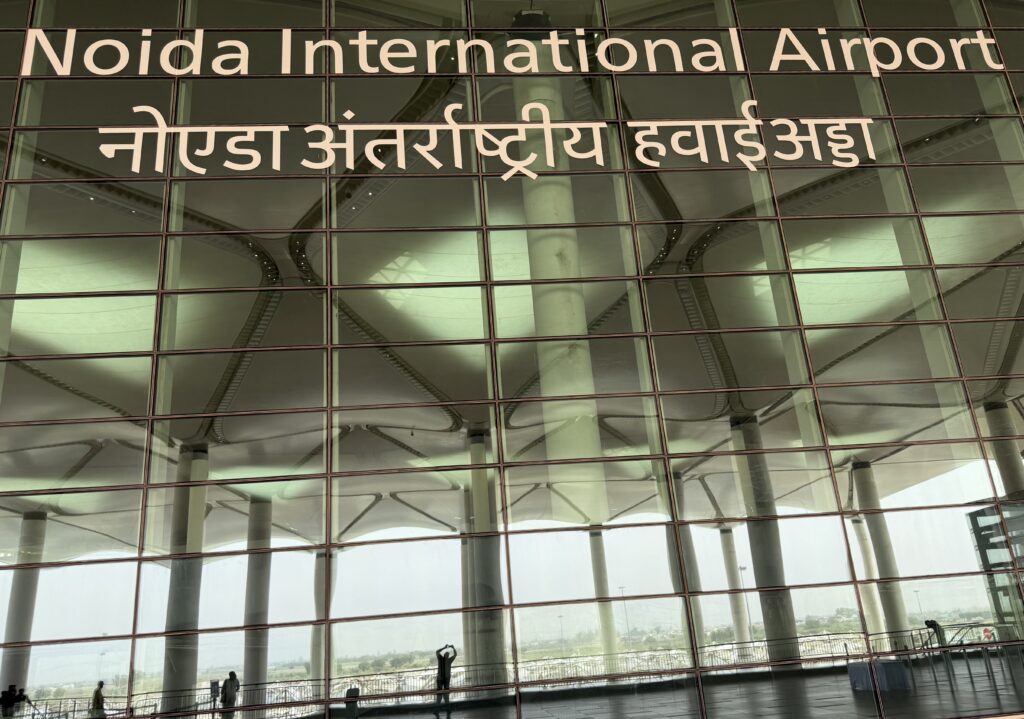
NCR joins the global multi-airport club
For decades, Delhi’s Indira Gandhi International Airport (IGIA) has served as the primary gateway for North India. However, passenger growth in the NCR has continued at a rapid pace, necessitating additional airport infrastructure.
With the opening of Noida International Airport, Delhi NCR joins a select group of global metropolitan regions served by multiple commercial airports. The airport is expected to serve not only Noida and Greater Noida, but also large parts of Western Uttar Pradesh, Uttarakhand, Haryana and Rajasthan.
Located along the Yamuna Expressway, the airport has been positioned as both an aviation and logistics hub, complementing the capacity available at Delhi Airport and Hindon Airport.
The airport was formally inaugurated by Prime Minister Narendra Modi in March 2026 and subsequently completed extensive Operational Readiness, Activation and Transition (ORAT) trials before welcoming its first passengers.
IndiGo leads the way
IndiGo has become the launch carrier at Noida International Airport, as per an earlier agreement signed between the airport and IndiGo.
Initially, the airline will connect the airport to more than 16 destinations across India and enable one-stop connectivity between several Tier-2 and Tier-3 city pairs. Examples include connections between Amritsar and Jodhpur, Bareilly and Bhopal, Chandigarh and Pantnagar, Jaipur and Dharamshala, among others.
The carrier’s first scheduled services include Bengaluru, Hyderabad, Amritsar, Jammu and Lucknow, with a broader route rollout planned through July 2026. Destinations such as Bareilly, Bhopal, Chandigarh, Dehradun, Dharamshala, Jaipur, Jodhpur, Kishangarh and Pantnagar will also be added over the coming weeks.
Commenting on the launch, Aloke Singh, Chief Strategy Officer of IndiGo, said that the opening of Noida International Airport represents “a new chapter in India’s aviation story” and highlighted the importance of the airport for Western Uttar Pradesh and the wider NCR region.
The airport now becomes IndiGo’s third operating airport in the NCR after Delhi and Hindon.
Akasa Air will also launch operations on June 16, 2026 (tomorrow). Air India Express had also committed to a launch, but has postponed its plans for now given the airline group’s current troubles. For Akasa, DXN will offer a chance to grow without having to worry about slots, for the time being. Eventually, they will also get night parking slots at the airport.
Designed for future growth
Phase 1 of Noida International Airport has been designed to handle 12 million passengers annually, although the long-term masterplan is substantially larger.
According to the airport operator, Zurich Airport International, the airport is planned for eventual expansion beyond 70 million passengers per year over the life of its concession. The current phase includes a single runway and one passenger terminal.
Passengers can expect a highly digital experience from day one. The airport offers DigiYatra-enabled processing, self-service check-in and baggage drop facilities, while aiming to minimise document checks and waiting times.
Architecturally, the airport incorporates design cues inspired by Uttar Pradesh, including terminal forecourts reminiscent of Varanasi’s ghats, ornamental lattice screens inspired by traditional havelis, extensive natural lighting and a central courtyard concept intended to create a calmer passenger experience.
Cargo ambitions are equally large
Passenger traffic is only one part of the airport’s plans.
Noida International Airport has also launched dedicated cargo facilities developed by AISATS, with an initial annual handling capacity of 200,000 metric tonnes. The cargo ecosystem is expected to expand significantly over time, eventually targeting a capacity of up to 1.5 million tonnes annually. The airport is also implementing digital cargo processes, including IATA’s e-Freight framework, to facilitate paperless logistics operations.
Given its location close to major industrial and manufacturing clusters in Uttar Pradesh, the cargo operation could emerge as one of the airport’s key growth drivers.
What comes next?
While domestic operations have now begun, international flights are expected to commence in the coming months. Airport officials say transport connectivity has been planned from the outset, with taxi operators, app-based cab services, and dedicated bus routes linking the airport to Delhi-NCR and key cities across North India. (Although, from personal experience, Google Maps did not do a great job this morning navigating us to the venue)
For now, the opening represents the culmination of a project that has been discussed for well over a decade and is expected to reshape aviation dynamics in North India.
The biggest question will be how quickly airlines scale up operations. While the airport’s long-term potential is undeniable, carriers have so far adopted a measured approach to capacity deployment, preferring to build traffic gradually rather than shift large volumes overnight from Delhi Airport. That cautious approach is likely to continue over the coming months as passenger demand patterns become clearer.
Bottomline
Noida International Airport has officially entered India’s aviation map. With IndiGo launching the first commercial services, NCR now has a second major airport capable of supporting future passenger and cargo growth. While airlines are initially taking a conservative approach to expansion, the opening of Jewar Airport represents one of the most important aviation infrastructure developments in India in recent years and lays the foundation for a multi-airport future for the Delhi NCR region.
What do you think of the opportunity for Noida International Airport?
Liked our articles and our efforts? Please pay an amount you are comfortable with; an amount you believe is the fair price for the content you have consumed. Please enter an amount in the box below and click on the button to pay; you can use Netbanking, Debit/Credit Cards, UPI, QR codes, or any Wallet to pay. Every contribution helps cover the cost of the content generated for your benefit.
(Important: to receive confirmation and details of your transaction, please enter a valid email address in the pop-up form that will appear after you click the ‘Pay Now’ button. For international transactions, use Paypal to process the transaction.)
We are not putting our articles behind any paywall where you are asked to pay before you read an article. We are asking you to pay after you have read the article if you are satisfied with the quality and our efforts.


Leave a Reply