

One of aviation’s most ambitious projects is now a significant step closer to becoming reality. The first Airbus A350-1000ULR (Ultra Long Range) destined for Qantas’ Project Sunrise programme successfully completed its maiden flight yesterday, marking the beginning of the flight-test and certification phase before the aircraft enters commercial service. Once operational, these specially modified aircraft will allow Qantas to operate the world’s longest non-stop passenger flights, linking Australia directly with destinations such as London and New York.
The aircraft completed its first flight from Airbus’ facilities in Toulouse, France, spending several hours in the air as engineers evaluated the aircraft’s systems and performance. The milestone is particularly significant because the aircraft is not just another A350-1000 rolling off Airbus’ production line; it represents the most capable ultra-long-haul commercial aircraft ever built.
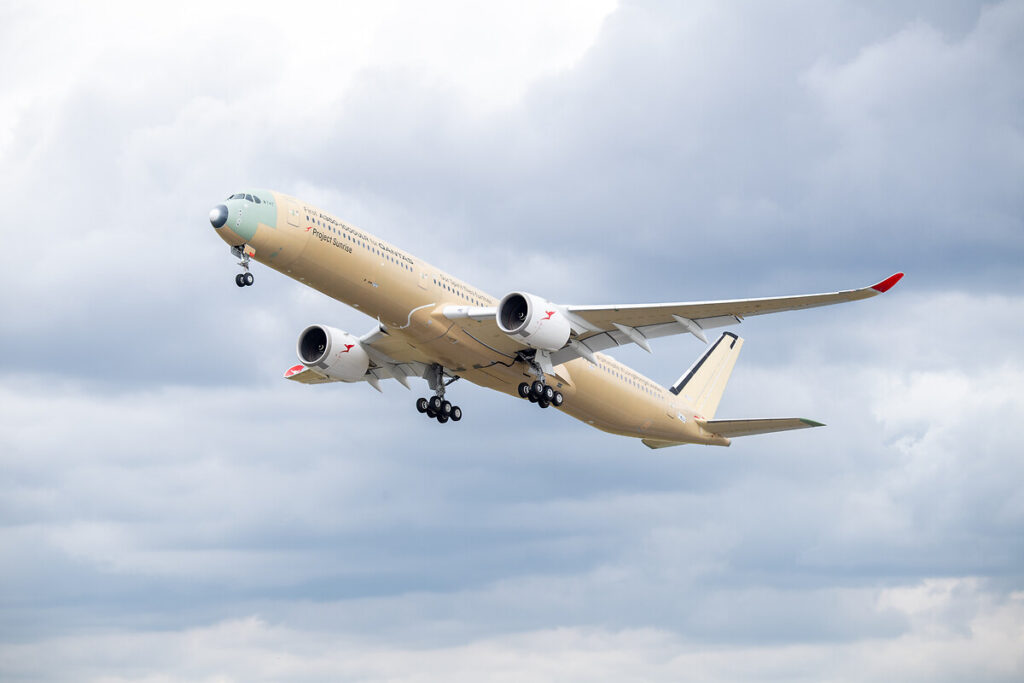
First Test Flight of Project Sunrise designated A350-1000 (ULR): Image via Airbus.
What Is Project Sunrise?
For more than a decade, Qantas has pursued the goal of eliminating the final major geographic disadvantage Australia faces: distance.
While aircraft technology has steadily improved over the years, Australia remains one of the world’s most isolated major aviation markets. Even today, passengers travelling between Australia’s east coast and Europe or North America typically require at least one stop en route.
Project Sunrise was conceived to change that. The initiative takes its name from the famous “Double Sunrise” flights operated during World War II between Australia and Sri Lanka, where passengers witnessed two sunrises because of the extraordinary duration of the journey.
Qantas formally launched Project Sunrise in 2017, challenging aircraft manufacturers to develop an aircraft capable of operating routes such as Sydney-London and Sydney-New York non-stop while carrying a commercially viable payload.
After extensive evaluation, Airbus emerged victorious over Boeing, with the airline selecting the Airbus A350-1000 as the platform for these groundbreaking flights.
In 2022, Qantas placed an order for 12 specially configured Airbus A350-1000 aircraft to operate Project Sunrise services.
The World’s Longest-Range Airliner
While based on the standard Airbus A350-1000, the Project Sunrise aircraft incorporates a number of modifications designed specifically for ultra-long-haul operations. Airbus describes the aircraft as the A350-1000ULR (Ultra Long Range), a variant designed to push the limits of commercial aviation. The aircraft will be capable of flying approximately 10,000 nautical miles, enabling nonstop operations of up to 22 hours, depending on winds and payload.
According to Airbus, the aircraft’s maiden test flight lasted more than two hours and involved evaluating major aircraft systems while validating performance characteristics before moving into a broader test campaign. It was operated by two Airbus Flight Test Pilots, three Flight Test Engineers and one Ground Test Engineer.
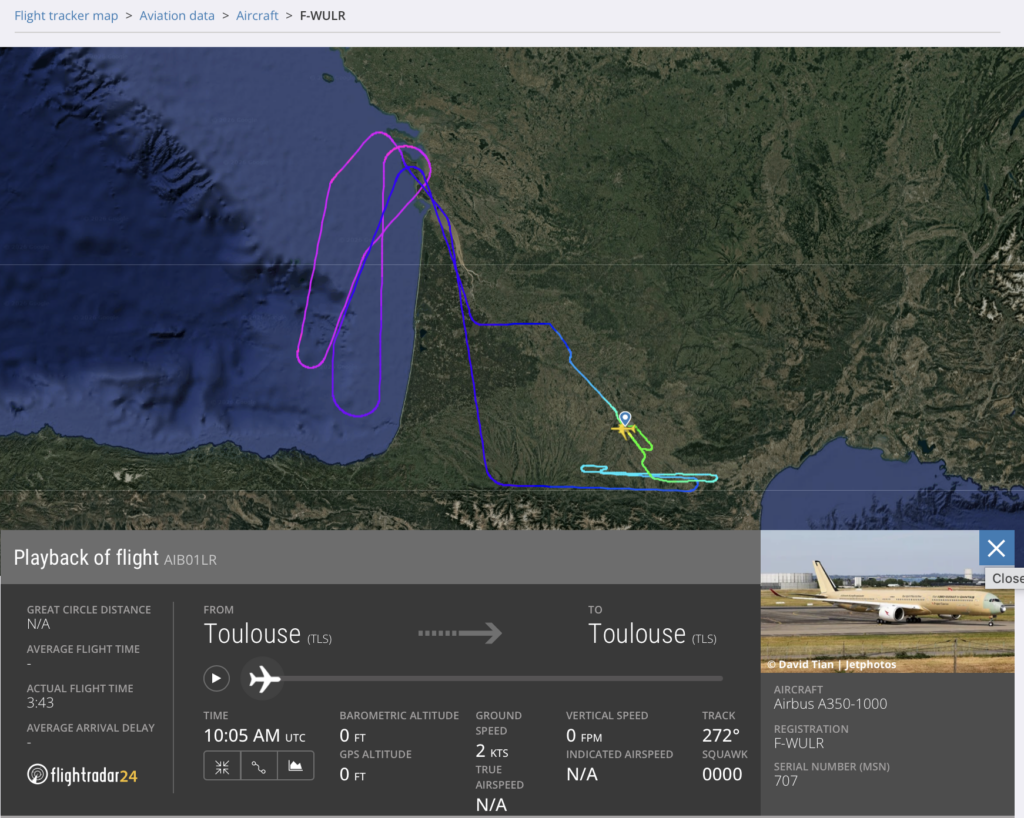
First Flight data via FlightRadar24
Benoît de Saint-Exupéry, Airbus Executive Vice President Sales of the Commercial Aircraft business, highlighted the significance of the milestone:
The A350-1000ULR will open new possibilities for airlines and passengers alike, enabling direct connections previously considered beyond reach.
The aircraft is powered by Rolls-Royce Trent XWB engines, already regarded as among the most efficient large commercial aircraft engines in service today.
Qantas Has Been Testing Ultra-Long-Haul Flying For Years
Project Sunrise has not simply been about obtaining a longer-range aircraft. Qantas has spent years studying the physiological and operational implications of flights lasting nearly an entire day.
In 2019, the airline operated a series of research flights using Boeing 787-9 aircraft between New York and Sydney and between London and Sydney. These flights carried researchers, scientists, pilots, cabin crew, and selected passengers who participated in sleep, nutrition, movement, and well-being studies. The goal was to better understand how to minimise fatigue, improve alertness, and enhance passenger comfort during flights lasting up to 20 hours.
The results of these studies have directly influenced the design of the Project Sunrise cabins.
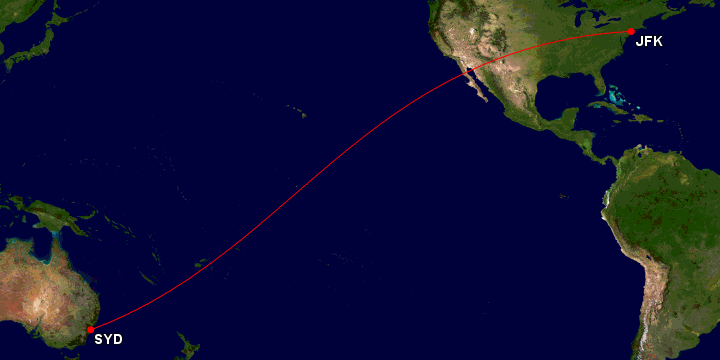
Sydney – New York JFK (9,950 Miles As the Crow Flies, via gcmap.com)
A Different Cabin Philosophy
Perhaps the most remarkable aspect of Project Sunrise is that Qantas is not using the additional range of the aircraft to cram more seats on board. Instead, the airline has adopted a passenger-focused approach, accepting a lower seat count in exchange for greater comfort.
The aircraft will feature just 238 seats across four cabins, significantly fewer than a conventional A350-1000. Passengers will have access to:
- Six First Class suites
- Fifty-two Business Class suites
- Forty Premium Economy seats
- One hundred and forty Economy seats
In addition, Qantas is introducing what it calls a “Wellbeing Zone”, a dedicated space where passengers can stretch, hydrate and move around during the flight. The concept acknowledges that passengers will spend up to 22 hours onboard and therefore require a fundamentally different onboard experience compared to traditional long-haul flights.
Speaking about the aircraft’s arrival, Qantas Group CEO Vanessa Hudson described Project Sunrise as “the final frontier of aviation.”
Why These Flights Matter
The economics of ultra-long-haul flying have often been debated. Longer flights require additional fuel, crew and operational planning. However, they also eliminate the inconvenience of stopovers and allow airlines to command premium fares from travellers willing to pay for time savings and convenience.
The success of routes such as Perth-London, operated by Qantas since 2018, has demonstrated strong demand for nonstop travel even on flights lasting nearly 18 hours.
Project Sunrise takes that concept even further. For premium travellers, avoiding an intermediate stop can save several hours and remove the uncertainty associated with missed connections, immigration formalities and airport transfers.
For corporate travellers in particular, a direct Sydney-London or Sydney-New York flight could become one of the most valuable time-saving products in global aviation.
What Happens Next?
With the maiden flight now complete, Airbus will continue an extensive programme of testing, certification and cabin completion activities before delivering the aircraft to Qantas, a process that will last for two months. A second aircraft is being fitted out with the entire LOPA planned for the aircraft, in Qantas livery. That will be the first A350-1000ULR Qantas expects to receive in the coming months, followed by crew training and route-proving exercises.
Commercial operations are currently planned to begin in 2027, with Sydney-London and Sydney-New York expected to be among the launch routes. Qantas will announce the first Project Sunrise route and timing of its inaugural commercial services later this month.
Bottomline
Qantas’ Project Sunrise has crossed another major milestone with the successful maiden flight of its first Airbus A350-1000ULR. The aircraft will eventually operate the world’s longest commercial flights, connecting Australia’s East Coast directly with cities such as London and New York.
Beyond simply setting distance records, Project Sunrise represents a rethink of ultra-long-haul travel, combining new aircraft technology, passenger wellness research and a premium-focused cabin design to make flights of up to 22 hours commercially viable. With certification now underway, the era of true non-stop global connectivity is approaching.
What do you think of flying 22 hours in one go?
Liked our articles and our efforts? Please pay an amount you are comfortable with; an amount you believe is the fair price for the content you have consumed. Please enter an amount in the box below and click on the button to pay; you can use Netbanking, Debit/Credit Cards, UPI, QR codes, or any Wallet to pay. Every contribution helps cover the cost of the content generated for your benefit.
(Important: to receive confirmation and details of your transaction, please enter a valid email address in the pop-up form that will appear after you click the ‘Pay Now’ button. For international transactions, use Paypal to process the transaction.)
We are not putting our articles behind any paywall where you are asked to pay before you read an article. We are asking you to pay after you have read the article if you are satisfied with the quality and our efforts.


Leave a Reply