

The chatter around IndiGo abandoning long-haul is louder than ever. Here’s the full timeline of how India’s largest airline got into the widebody business — and how it ended up here.
For a project meant to be the curtain-raiser for IndiGo’s transformation into a global airline by 2030, the long-haul story has had an unusually compressed arc. In just over a year, IndiGo went from announcing its first wet-leased Boeing 787-9 to flying daily to London Heathrow, before geopolitics and a fragile fleet plan combined to ground the entire operation. With the chatter now turning to whether IndiGo will simply walk away from long-haul until its own A350s arrive, here is the full timeline.
The original itch: a no-frills long-haul that never happened
IndiGo’s interest in flying beyond its narrowbody comfort zone is not new. Back in 2018, we wrote about how IndiGo had been eyeing long-haul for years, considering a no-frills model on aircraft like the Airbus A330 to take on legacy carriers on routes like London. The plan never materialised — partly because the airline first tried to take a shortcut by attempting to absorb Air India’s international network, slots, bilaterals and all in 2017.
That gambit failed, and for the next few years, IndiGo focused on what it knew: dense narrowbody operations and steady regional growth. The widebody dream was filed away, but never abandoned.
The pivot: from 2027 to 2025
Two things changed everything, both under Pieter Elbers’ leadership.
First, IndiGo placed a landmark order for 30 Airbus A350-900s, with first deliveries scheduled for 2027. Second — and far more consequential in the short term — the Indian government relaxed wet-lease rules during the year-end break, extending the maximum permissible term from six months to eighteen.
Almost on cue, in November 2024, Norse Atlantic Airways told its investors it had signed a Letter of Intent with an unnamed “reputable international airline” to wet lease six 787-9s, with an estimated contract value of USD 462 million over the extended term. By January 2025, we had pieced together that the customer was IndiGo and that the airline had decided not to wait for its own A350s to arrive. The phrase we used at the time captured it well: this was a pivot from flying long-haul in 2027 to flying long-haul in 2025.
The reasoning was sensible. Slots at airports like London Heathrow are notoriously slot-constrained, and bilateral entitlements between India and various European countries had to be claimed before Air India locked them all up. Waiting until 2027 risked starting the race already several laps behind.
The deal gets formal
On February 6, 2025, IndiGo and Norse officially confirmed the damp lease project. The first 787-9 would arrive in March 2025, with an initial six-month term extendable up to eighteen months. The structure was clear: Norse would supply the aircraft, the cockpit crew, and maintenance; IndiGo would supply its own cabin crew and sell the seats — the same model the airline already used with the two Turkish Airlines-operated 777s on the Istanbul routes.
Within weeks, the deal grew. By late February 2025, IndiGo confirmed three additional 787-9s, taking the total to four. By early May 2025, two more were added, bringing the count to the full six aircraft Norse had originally floated. Pieter Elbers, IndiGo’s CEO, framed each expansion as another step toward the airline’s stated vision of becoming a global player by 2030.
The first Norse 787-9 entered service on the Delhi–Bangkok rotation in March 2025 — explicitly a familiarisation deployment, intended to let IndiGo’s cabin crew, ground teams and systems get comfortable with widebody operations before the real test in Europe.

IndiGo’s first 787-9 departure from Manchester
The big bang launch
In May 2025, IndiGo formally announced what we had been reporting for months: the airline’s first true long-haul routes, Mumbai–Manchester and Mumbai–Amsterdam, would commence on July 1 and 2, 2025, respectively. Three times a week, each to begin with, on the Norse 787-9.
What was striking was not just the routes, but how aggressively IndiGo had decided to premiumise around the launch. Hot meals would be served complimentary in both cabins — a first for an airline that had never offered free hot food before. Stretch passengers would get lounge access at Mumbai (eventually the Adani West lounge), Schiphol and Manchester. Baggage allowances were generous: 30 kg in economy, 46 kg in Stretch. Sula Wines was signed up to provide canned wines on board.
The aircraft itself was a known quantity — the same 338-seat configuration (56 premium recliners in 2-3-2, 282 economy in 3-3-9) that Norse had originally flown for Norwegian Air UK. Stretch was sold as Business Class, even though the seats were recliners rather than lie-flats with around 43 inches of pitch and 12 inches of recline.
The first flight
I was on the inaugural Mumbai–Manchester service, and the first impressions were broadly positive. The cabin crew were still finding their feet on widebody operations, but the soft product was solid: warm towels in Stretch, an amenity basket with the essentials, two hot meals per sector, welcome drinks — Aam Panna and Apple-Beetroot-Carrot juice rather than champagne — and the airline’s signature Chicken Parda Biryani out of Mumbai. The hard product was a notch above premium economy and a notch below proper business class, but at the price points IndiGo was offering, it was a genuinely competitive proposition.
This was, as we noted at the time, IndiGo’s moment of hybridisation. The 787-9 was always understood as a stop-gap for around 18 months while the airline waited for its own A350s. But it was also a glimpse of where the brand was headed.
Expansion, expansion, expansion
The momentum carried through the rest of 2025 and into early 2026:
– Copenhagen was announced as the third long-haul city, launched on October 8, 2025 — IndiGo’s debut in Scandinavia and its 44th international destination.
– London Heathrow from Mumbai launched daily.
– Delhi–Manchester launched in November 2025, four times a week.
– Delhi–London Heathrow launched on February 2, 2026 — daily.
– The first A321XLR was inducted in January 2026, with Athens services from Mumbai and Delhi as the first own-metal long-haul routes.
By the start of 2026, IndiGo had six 787-9s working five European cities from two Indian gateways, plus its A321XLR. Norse, for its part, had handed over half of its 12-strong fleet to IndiGo — the Norwegian carrier was effectively reorienting itself around the IndiGo contract.
And then the cracks
The first signs of strain showed up not in the headlines, but in the schedule. In early February 2026, IndiGo announced what it called a “rejig” of its 787-9 network. Copenhagen was suspended from February 17 until further notice. Delhi–Manchester was cut from five weekly to four (from February 7), then to three (from February 19). Delhi–London Heathrow was reduced from five weekly to four. The airline’s own statement pointed to changes in airspace restrictions, geopolitical circumstances, and airport congestion.
The undertone was unmistakable. With only six widebodies, no spare aircraft, and routes already lengthened by Pakistan’s continued closure of its airspace to Indian carriers, IndiGo simply did not have enough buffer in the system to absorb delays. One late arrival could cascade across the network. Copenhagen, in particular, looked less like an airspace casualty and more like a commercial decision dressed in operational clothing.
The Middle East shock
What had been a manageable squeeze turned into a full-blown crisis at the end of February 2026. The escalating conflict involving Iran led to widespread airspace closures across Iran, Iraq, Israel, Kuwait, Qatar and the UAE — effectively cutting out the corridor on which IndiGo’s Europe flights depended.
For most Indian carriers, this was painful. For IndiGo, it was paralysing. Because the 787-9s are operated under Norse’s Norwegian Air Operator’s Certificate, the fleet falls under EASA’s regulatory oversight, and EASA’s advisory restricting flights over the affected West Asian airspaces applies directly to these aircraft. With Pakistan closed to Indian carriers and the Middle East corridor closed to EASA-regulated aircraft, there was no commercially viable westbound path left.
Norse confirmed in its monthly update that all six 787-9s placed with IndiGo were grounded because the ACMI operation was temporarily suspended.
Flights to nowhere
Operations restarted on March 8, 2026, with a Mumbai–London Heathrow service. The relief lasted barely a day.
That same week, IndiGo’s European Flight became a “flight to nowhere” — departing Delhi, getting airborne, and being forced to turn back mid-flight after Eritrea’s air traffic control denied airspace clearance. The flight was filed under IndiGo’s callsign, but the aircraft registration belonged to Norse Atlantic, and Eritrean ATC apparently didn’t reconcile the two. The same thing happened to 6E2 from London Heathrow, which had to divert to Cairo for the same reason.
Two diversions on the same day, both due to a paperwork quirk that should never have surfaced if the airspace situation had been working normally. The whole affair underlined just how brittle the operation had become.
So, is IndiGo killing long-haul? No.
Here is where the chatter is now, and here is what the record actually shows.
IndiGo has not announced an exit from long-haul. The contract with Norse remains in place, and the airline has consistently pointed to the A350-900 fleet as the long-term answer. The Norse 787s were always a bridge, never the destination.
But the bridge has buckled in ways nobody planned for. The strategy assumed a stable air corridor over West Asia, friendly bilateral airspace, and a small fleet operating with tight rotations. All three assumptions have been challenged simultaneously. Even before the Iran conflict, IndiGo was already trimming Copenhagen, Manchester and Heathrow to protect schedule reliability. After the conflict, the entire network was grounded for a week, restarted, and then immediately disrupted again by airspace denials over Eritrea.
The structural vulnerability is clear. Foreign-registered aircraft under EASA oversight; no Pakistan overflight; only six aircraft; no spares; contractual block hours that have to be paid regardless—none of it leaves much room for the next geopolitical surprise. Add the broader pressure on the airline (the FDTL-related pilot shortage that forced cancellations through December 2025, the loss of the Turkish 777 wet lease in August 2025, the broader cost pressures from rising fuel surcharges), and it becomes easy to see why the question is being asked.
For now, the following dates are when the flights close out:
- Mumbai – Manchester – August 31, 2026
- Delhi-Manchester – August 29, 2026
- Delhi – London Heathrow – October 24, 2026
- Mumbai – Amsterdam – October 24, 2026
- Mumbai – London Heathrow – October 24, 2026.
Flights beyond these dates have already been withdrawn from sale. [Update: IndiGo started posting the flights back online at about 10:30 PM IST.]
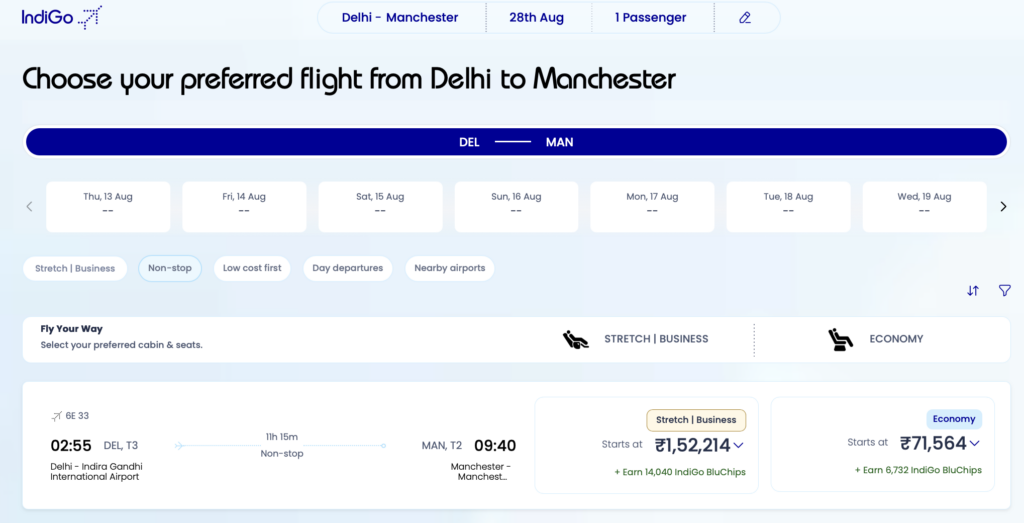
IndiGo’s Delhi – Manchester flights are blanked out after August 28, 2026
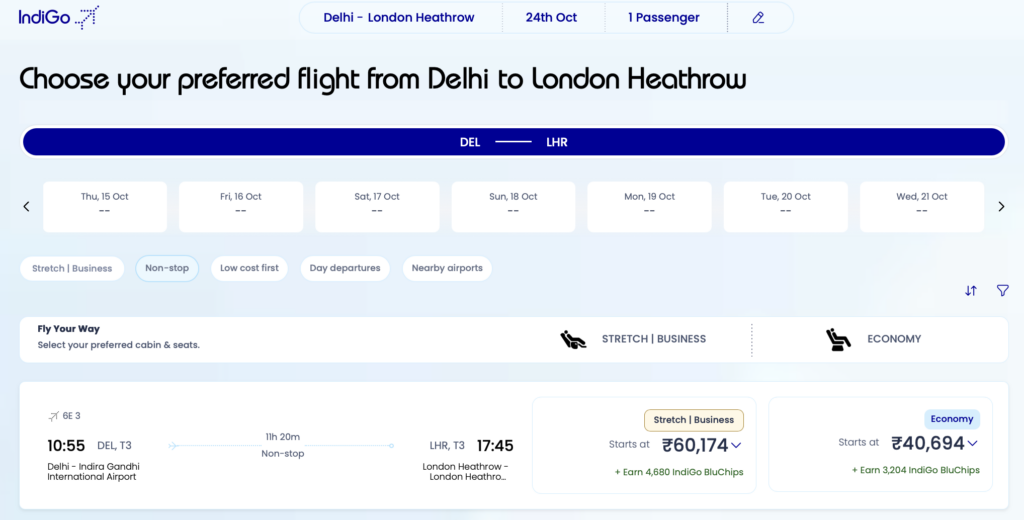
IndiGo’s Delhi – London Heathrow flights are blanked out after October 24, 2026
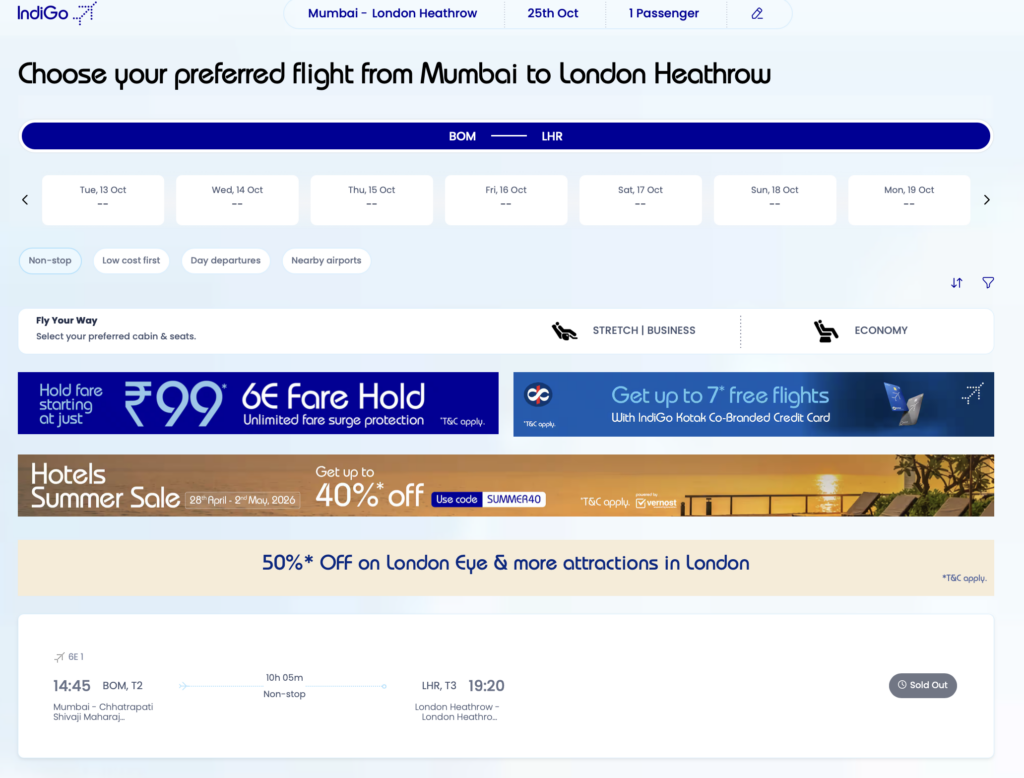
IndiGo’s Mumbai – London Heathrow flights are blanked out after October 24, 2026
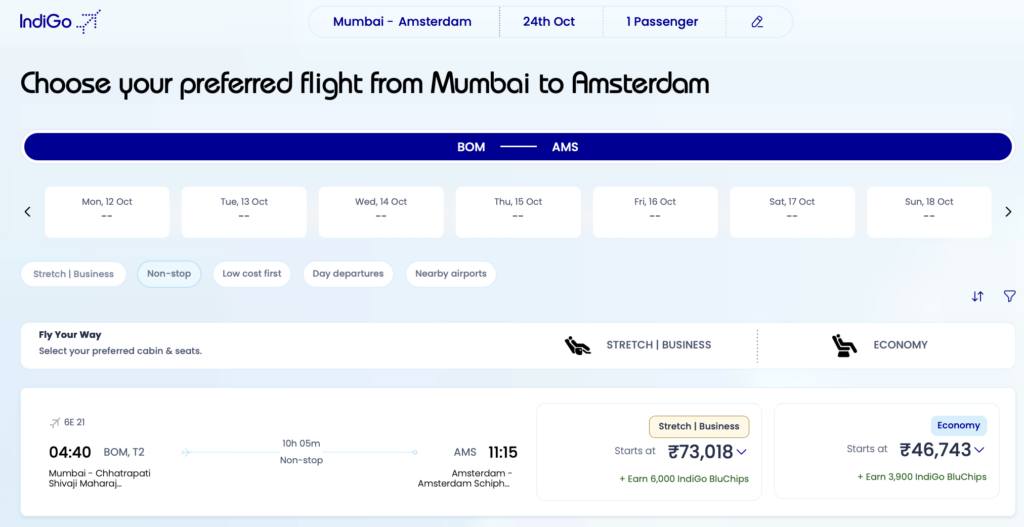
IndiGo’s Mumbai – London Heathrow flights are blanked out after October 24, 2026
Now, there could be multiple reasons for this move. For one, the airline’s chief sponsor of the move, Pieter Elbers, has left the chat. For two, based on social media chatter, the flights did not achieve the desired occupancy. For three, it could just be a holding pattern. The airline certainly has enough of a war chest to fund and support these operations, unless current fuel prices make them unviable.
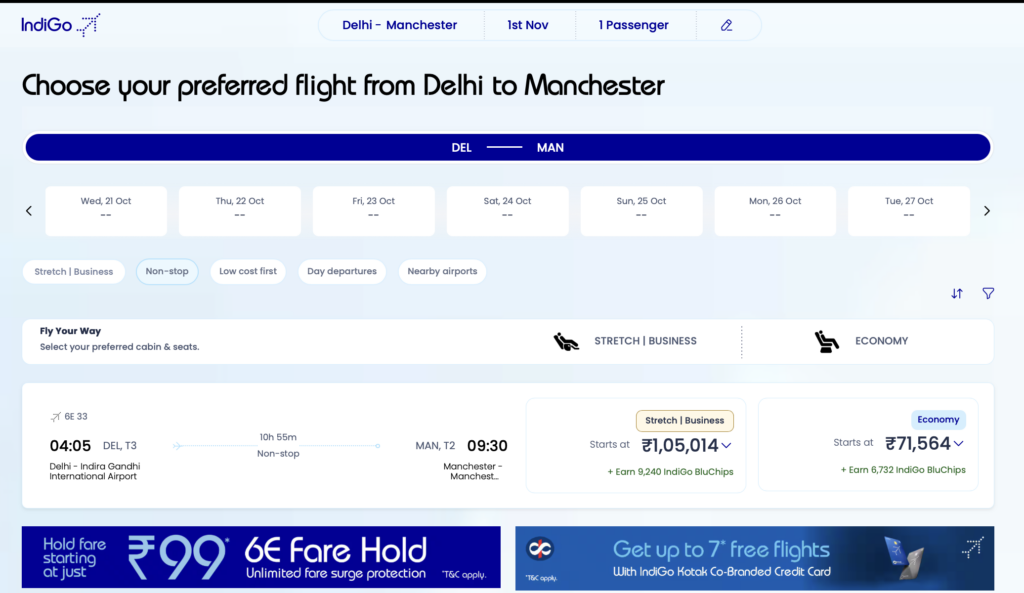
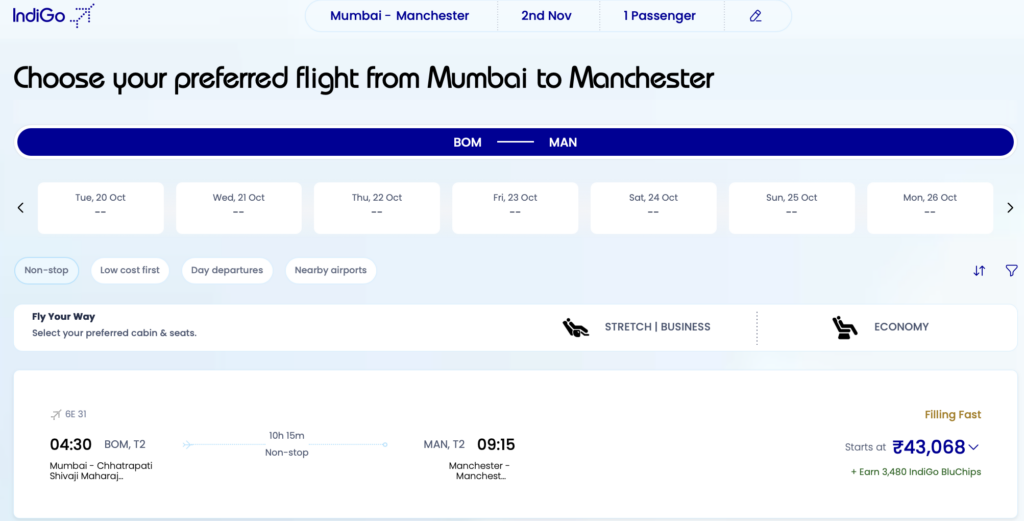
As indicated a little bit ahead, these flights are now back on sale. For instance, here are flights to Manchester on sale for November 2026. London Heathrow flights are similarly back up for sale.
What do you make of where IndiGo’s long-haul story has ended up? Is this a temporary stall, or is the chatter about an exit closer to the truth than the airline is letting on?
Liked our articles and our efforts? Please pay an amount you are comfortable with; an amount you believe is the fair price for the content you have consumed. Please enter an amount in the box below and click on the button to pay; you can use Netbanking, Debit/Credit Cards, UPI, QR codes, or any Wallet to pay. Every contribution helps cover the cost of the content generated for your benefit.
(Important: to receive confirmation and details of your transaction, please enter a valid email address in the pop-up form that will appear after you click the ‘Pay Now’ button. For international transactions, use Paypal to process the transaction.)
We are not putting our articles behind any paywall where you are asked to pay before you read an article. We are asking you to pay after you have read the article if you are satisfied with the quality and our efforts.


Their Athens flights seem to be doing well. The two Mumbai-Athens flights that I have taken with them had economy almost full and Stretch with 50% occupancy. Mostly Europeans looking for a direct connection to that side of Europe. They have a good product on the A321XLR. Not sure if a wide body would sustain on that route though.
Not surprised to see this. The Indian government trying to be nonchalant about Pakistan airspace isn’t helping. Imagine what they could’ve done in March (and even now) when Gulf capacity was almost gone. Instead, they operated no flights in the first week, and then obviously the Africa circus.