

Air India had a rough operational day yesterday. But this wasn’t about delays, weather, or even a technical snag. This was about sending the wrong aircraft on an international flight — and realising it only after the plane had spent hours in the air.
In a bizarre turn of events, a Delhi–Vancouver service had to be turned around mid-air over China and brought back to Delhi after it emerged that the aircraft operating the flight lacked the regulatory approvals required to enter Canadian airspace.
Air India’s 777 flies to Vancouver, only to turn back
On March 19, 2026, Air India flight AI185 departed Delhi for Vancouver as scheduled. Everything appeared normal — until it wasn’t. Several hours into the flight, while cruising over Chinese airspace, the airline discovered that the aircraft assigned to the route was not authorised to operate into Canada. At that point, there was only one option: turn around.
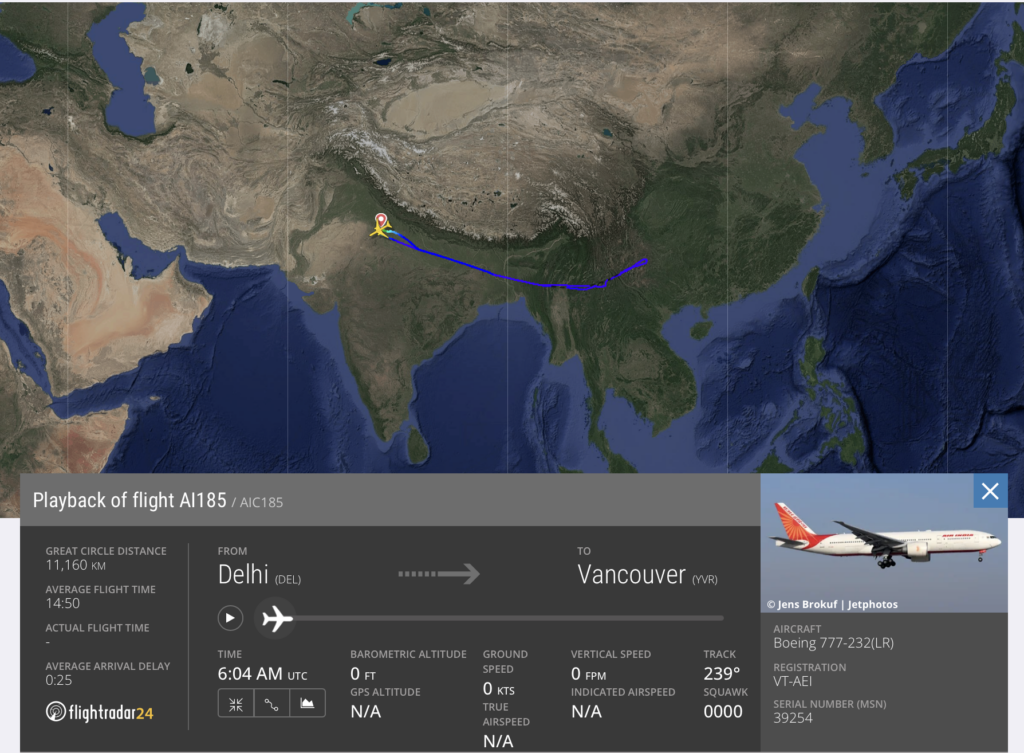
AI 185 Delhi – Vancouver, diverted to Delhi on March 19, 2026
The aircraft reversed course and headed back to Delhi, completing roughly nine hours of flying time without ever reaching its destination. Passengers, effectively, experienced a long-haul “flight to nowhere.”
Not a technical issue, but a rostering error
What makes this incident particularly striking is that there was no mechanical failure involved. Instead, the issue came down to aircraft assignment. It’s only the Air India staff’s fault.
Air India is currently cleared to operate its Boeing 777-300ER aircraft into Canada. However, the airline deployed a Boeing 777-200LR on this rotation — a variant that lacks the required approvals for Canadian operations. For most passengers, this distinction is academic. For regulators, it is everything. And in this case, that difference meant the aircraft would not have been permitted to land in Canada.
The incident was first reported by The Times of India
How does something like this even happen?
Assigning an aircraft to a long-haul international flight is not a casual decision. It involves rostering, fleet planning, regulatory compliance checks, route-specific clearances, and coordination among dispatch, operations, and network planning. All of this is typically locked in well before departure. For an aircraft without the right approvals to be assigned — and to actually depart — suggests a breakdown somewhere in that chain.
Whether it was a last-minute equipment swap gone wrong or a deeper systems issue, Air India will need to explain internally. This aircraft, the sole one remaining from the ex-Delta fleet that Air India brought in, is used exclusively for Delhi-Frankfurt operations and is also scheduled to return to the lessor after the end of March 2026.
Air India issued a statement on this incident, calling it an operational issue.
Air India flight AI185, operating from Delhi to Vancouver on 19 March, returned to Delhi due to an operational issue and in line with established standard operating procedures. The aircraft landed safely, and all passengers and crew had disembarked.
We sincerely regret the inconvenience caused to our guests by this unforeseen situation. Our ground teams in Delhi had provided all necessary assistance, including offering hotel accommodation, while every effort was made to fly the passengers to their destination at the earliest. The flight departed this morning for Vancouver with the passengers.
At Air India, the safety and well-being of our passengers and crew remain our highest priority.
Passenger impact
By the time the aircraft landed back in Delhi, passengers had spent close to nine hours in the air — only to end up where they started. Air India arranged accommodation and rebooking, but the disruption was significant, especially on long-haul international sectors where passengers are often connecting onward or travelling for time-sensitive commitments.
While safety was never in question, the optics certainly are.
The timing couldn’t be worse. This episode comes at a delicate time for Air India. The airline is in the middle of a high-visibility transformation, reactivating grounded aircraft, upgrading cabins, rebuilding its global network, and trying to reposition itself as a reliable full-service carrier. Operational lapses like this don’t just cause inconvenience — they dent credibility. And credibility is exactly what Air India is trying to rebuild.
Bottomline
This wasn’t a safety incident. It was, in many ways, worse — an avoidable operational failure. Air India flew AI185 on an aircraft that was not approved for the mission, costing an expensive 9 hours’ worth of jet fuel and time, and had to turn it around after the mistake was realised. I’m wondering if this was a stupid intern-level mistake or a high-level mistake that’s more about incompetence.
What do you make of the Air India snafu with the flight operation between Delhi and Vancouver?
Liked our articles and our efforts? Please pay an amount you are comfortable with; an amount you believe is the fair price for the content you have consumed. Please enter an amount in the box below and click on the button to pay; you can use Netbanking, Debit/Credit Cards, UPI, QR codes, or any Wallet to pay. Every contribution helps cover the cost of the content generated for your benefit.
(Important: to receive confirmation and details of your transaction, please enter a valid email address in the pop-up form that will appear after you click the ‘Pay Now’ button. For international transactions, use Paypal to process the transaction.)
We are not putting our articles behind any paywall where you are asked to pay before you read an article. We are asking you to pay after you have read the article if you are satisfied with the quality and our efforts.


To imagine how many systems, checks and balances failed that this flight took off.
P.S. The new AI PE commercial TVC seems well done though. Wonder if it was in house team or which agency.
@Prashant, Just one I believe, the rostering one