

The travel industry loves a good buzzword. “AI-powered.” “Personalised.” “Discovery.” But every once in a while, a launch appears that hints at something structurally different — a financial network and a travel marketplace attempting to fuse their data, incentives, and discovery engines into one system.
Mastercard’s “Lifestyle Navigator” is arriving soon on MakeMyTrip.
The travel industry has been flirting with generative AI for the past two years. Most implementations so far have been polite assistants bolted onto search engines. A chatbot here, an itinerary generator there. Useful, perhaps — but rarely transformative.
A new partnership between MakeMyTrip and Mastercard suggests the industry may be inching toward something more structural: a travel-planning interface that merges booking data, payment intelligence, and curated experiences into a single AI-driven system.
On Monday in New Delhi, the companies unveiled “Lifestyle Navigator,” an AI-powered travel and lifestyle concierge that will be integrated into MakeMyTrip’s generative AI trip planning assistant, Myra. The platform is Mastercard’s first global deployment of its white-label technology, with India becoming the inaugural market and MakeMyTrip the first online travel agency partner. Conversations are ongoing in many other geographies as well.
The move reflects a growing realisation across the travel industry: the real value of AI may not lie in answering questions, but in shaping the discovery journey before a traveller even decides where to go.
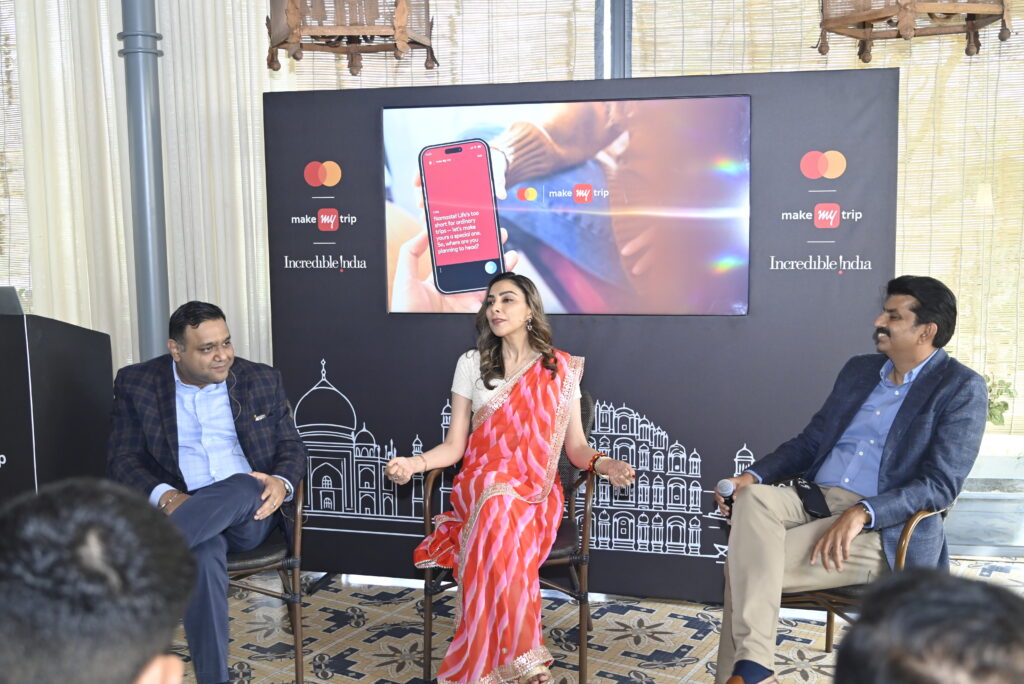
Gautam Aggarwal (Mastercard India), Kaveri Khullar (Mastercard Asia) and Rajesh Magow (MakeMyTrip) at the announcement of Lifestyle Navigator launch in India
A concierge, layered into the booking journey
The Lifestyle Navigator will sit inside Myra, MakeMyTrip’s conversational AI tool that helps travellers plan itineraries using natural language prompts. But the new layer aims to expand the assistant’s scope far beyond itinerary suggestions.
The system combines MakeMyTrip’s marketplace data — flights, hotels, destinations, traveller preferences — with Mastercard’s global merchant network, “Priceless Experiences,” and card-linked offers. The goal is to generate personalised recommendations for destinations, experiences, dining, retail, and even payment products that could maximise the traveller’s benefits.
Rajesh Magow, co-founder and group CEO of MakeMyTrip, said,
Our AI-powered Trip Planning Assistant, Myra, has been developed to convert data-led insights into personalised experiences that are timely and relevant for each traveller.
He further added,
We are very happy to collaborate with Mastercard to power the trip-planning experience with Lifestyle Navigator, providing a smooth experience for our travellers.
Unlike traditional travel search engines, which rely heavily on user queries, the platform uses large language models to interpret traveller intent — including destination preferences, travel companions, and personal interests — and generate suggestions dynamically. In practice, that could mean recommending a destination, highlighting a culinary experience, suggesting a hotel, and offering a relevant card-linked perk in a single, continuous flow.
MMT’s own travel chatbot has been answering as many as 65,000 conversations recently, per Magow.
Here is a demo of how Lifestyle Navigator will blend in upon launch.
Mastercard’s strategy: embedding payments into travel
For Mastercard, the partnership reflects a broader effort to embed its payments ecosystem into consumer digital journeys.
Gautam Aggarwal, president for India and South Asia at Mastercard, said at the launch,
Travel is about the moments that make each journey special.
With Lifestyle Navigator, we are entering a new era where discovery, planning and experiences come together through AI. By pairing Mastercard’s global network of offers and privileges with MakeMyTrip’s deep travel expertise, we’re harnessing AI and data intelligence in a way that is practical, trusted and deeply contextual.
The platform will also incorporate insights from specialists across food, culture, adventure, and retail in global destinations, as well as recommendations from travel creators and influencers.
Kaveri Khullar, senior vice president for consumer marketing and sponsorships for Asia Pacific at Mastercard, said,
The future of travel planning isn’t endless recommendations-it’s trusted intelligence. That insight led us to create Mastercard Lifestyle Navigator, a first-of-its-kind platform that combines AI, the expertise of leading travel and lifestyle creators, and relevant offers from Mastercard’s banking and merchant partners. The result is intelligence that travels with you, like having a well-connected local in your pocket, guiding you seamlessly from inspiration to experience.
That phrase — “trusted intelligence” — points to a subtle shift underway in travel technology. Khullar was referring to the Lifestyle Navigator’s ability to assimilate data from booking history, create a user persona over time, and then marry that with local recommendations that align with the user’s preferences.
The interface offered by MMT/Mastercard is not just a chatbot but a graphical user interface, which will make things easier to understand and absorb rather than just read and contextualise.
Why India is the launch market
India’s rapidly expanding travel ecosystem made it a natural starting point. According to Mastercard’s Economics Institute, India is projected to lead major Asia-Pacific economies in economic growth, driven by strong domestic demand and accelerating digitisation. The country’s travel market has rebounded strongly since the pandemic, supported by rising disposable incomes and widespread adoption of digital payments.
MakeMyTrip, meanwhile, remains the dominant online travel platform in the country — giving Mastercard access to a large and growing base of digital-first travellers.
The Lifestyle Navigator has been in development for 18 months and will be rolled out on the MakeMyTrip platform later this year.
The bigger shift: AI as the new travel interface
The deeper significance of the launch lies in how it reframes the role of an online travel agency. For decades, travel booking platforms have essentially been search engines with inventory. A traveller knows where they want to go, and the platform helps them book it.
Generative AI changes that model. Instead of simply responding to queries, AI systems can shape inspiration, suggest destinations, recommend experiences, and surface offers — effectively acting as a digital concierge. If travellers begin planning trips through AI-driven assistants rather than search engines, the companies that combine the most relevant data — travel inventory, payments insights, merchant partnerships, and loyalty ecosystems — will be best positioned to influence decisions.
That is why the MakeMyTrip–Mastercard partnership is notable. It connects three powerful datasets that rarely sit in the same system: travel bookings, consumer spending behaviour, and local merchant experiences. If executed well, the result could be something closer to a travel operating system than a simple booking tool.
Of course, the travel industry has heard similar promises before. AI assistants can easily become little more than marketing layers atop existing search flows. But if platforms like Lifestyle Navigator succeed in turning fragmented travel planning into a continuous, personalised journey — from inspiration to booking to in-trip spending — the way travellers discover and plan trips could begin to look very different.
And in that future, the travel industry’s most valuable real estate may not be the booking engine. It may be the AI concierge that decides what you see first.
Bottomline
Mastercard and MakeMyTrip have joined hands to launch the Lifestyle Navigator, an AI-powered concierge in India, within MMT’s Myra chatbot in a few months. Once live, customers of MakeMyTrip will be able to seek answers to their most pressing questions, such as the best hotel for them, the best breakfast in town and the most important activities for them to explore the town, all powered by the concierge, and supported by local inputs from tastemakers and creators on the ground.
What do you think of the new combination of AI with your travel booking engine?


Leave a Reply