

When strikes between Israel, the U.S., and Iran escalated into a region-wide exchange of missiles and drones in the last week of February 2026, the consequences were immediate and visible across the Gulf. The most consequential ripples for travel and hospitality were felt in the United Arab Emirates, specifically Dubai, where airspace closures, damage to critical infrastructure, and urgent civil defence measures forced rapid, high-stakes decisions by government bodies, airport authorities, and airlines. This dispatch synthesises official statements, reporting on airport damage and airline suspensions, and the UAE’s humanitarian posture to explain what happened, why it mattered for travel and tourism, and what follows.
The immediate government line: condemnation, restraint, and sovereignty
Within hours of strikes and cross-border retaliations, the UAE’s Ministry of Foreign Affairs issued a firm diplomatic statement condemning missile attacks that targeted the country and “brotherly nations,” framing the assaults as violations of sovereignty and international law. The ministry’s tone combined condemnation with a call for restraint and diplomacy — an effort to signal both national resolve and a preference for de-escalation. That posture matters: the UAE positions itself as a diplomatic broker and a commercial hub whose stability is central to trade, aviation and tourism.
At the same time, UAE authorities invoked emergency protocols: public alerts asked residents and visitors to seek shelter and avoid exposed areas; consular advisories from several nations urged caution; and local civil defence agencies activated response teams to deal with debris, fires and casualties reported in Dubai and Abu Dhabi. Those actions were defensive and pragmatic, focused first on civilian safety and second on restoring essential services.
Airports and airlines: safety first, then operational triage
The practical pivot that most directly affected travellers was the precautionary or partial closure of airspace and immediate changes to airport operations. Dubai International Airport sustained damage when debris from interceptions struck a concourse, causing injuries and a minor fire — incidents that forced the temporary suspension of some operations and triggered immediate contingency measures by airport authorities. Nearby infrastructure, including hotels such as the Fairmont Dubai and the Burj-al-Arab, and a Jebel Ali berth, also suffered damage.
UPDATE: Some flights at @DXB and Dubai World Central – Al Maktoum International (DWC) are cancelled or delayed due to partial UAE airspace closure. We urge you to check with your airline and not to head to DXB or DWC at this time.
— DXB (@DXB) February 28, 2026
Airlines headquartered in the UAE adjusted operations quickly. Emirates and other carriers announced suspensions, rebookings and reroutes as regional FIRs (flight information regions) were closed or rendered operationally unsafe.
Due to multiple regional airspace closures, Emirates has temporarily suspended operations to and from Dubai.
Emirates urges customers to check https://t.co/Ucm3UswfVh and https://t.co/yehFUeWZQq for the latest updates before proceeding to the airport.
We are actively monitoring… pic.twitter.com/SLDC7iNaUN
— Emirates Support (@EmiratesSupport) February 28, 2026
Similarly, Etihad Airways and the UAE’s low-cost carriers had to implement contingency plans: diverting in-flight aircraft, accommodating passengers at alternate airports, and working with airport partners to manage parking and handling capacity.
https://twitter.com/etihad/status/2028043988977192971?s=20
The General Civil Aviation Authority (GCAA) and airport operators coordinated advisories; where runways or terminals were affected, temporary closures and capacity constraints cascaded into cancellations and long-lasting schedule disruption.
Flights that relied on Gulf airspace for the most direct India–Europe or India–North America corridors faced long detours, crew-duty complications and, in many cases, cancellation.
In view of the current situation in the Middle East, Air India has cancelled all flights to destinations in the region until 2359 hours on 1 March.
We are closely monitoring developments and remain in continuous coordination with the relevant authorities. The…
— Air India (@airindia) February 28, 2026
Civil defence and the social dimension: shelter, messaging, and consular coordination
Beyond airports and airlines, UAE municipal and federal agencies used established emergency-notification channels to direct residents and tourists to shelters and safe spaces. Local media and social feeds provided real-time guidance on what to do in the event of incoming debris or further strikes. Foreign embassies — including India’s mission — issued advisories urging nationals to stay put and rely on local instructions.
Economic and reputational exposure for travel and tourism
The short-term economic fallout was obvious: hotel bookings were disrupted, inbound tourism flows stalled, and airlines lost seat-capacity on high-yield long-haul lanes. More structural exposure emerged in other ways. Dubai’s brand as a safe, always-open global hub is a commercial asset; visible damage to airport terminals or high-profile facilities (like the Burj Al Arab, which sustained exterior damage in reporting) risks eroding some of that trust if the narrative of instability persists. At the same time, the UAE’s fast, visible emergency response—airspace management, public alerts, and curated humanitarian messaging—helped contain reputational damage by signalling both capability and control.
UAE to support everyone who is stuck
As per the GCAA, the UAE’s aviation regulator, over 20,200 people were stuck at airports across the UAE, and the regulator issued a statement that all of them will be provided with temporary accommodation and meals until they can be brought home. Here is what the GCAA said,
The GCAA announced that the State is bearing all hosting and accommodation costs for affected and stranded passengers, ensuring the continued provision of essential services during the period of operational adjustments.
Here is the mandate that the Department of Culture and Tourism of Abu Dhabi provided to hotel owners and General Managers in Abu Dhabi, which somehow ended up in the public domain. It speaks of the DCT taking on the expense of the people who have to stay on longer in Abu Dhabi due to this instance.
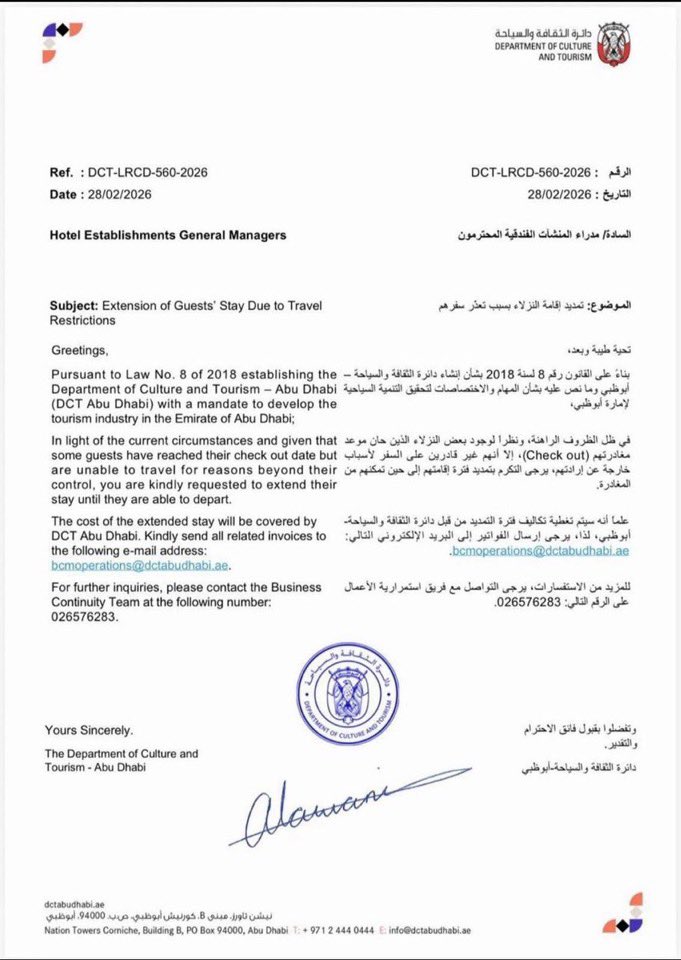
No wonder this approach has found positive feedback from people around the world. Given that this situation seems to be taking some time to clear up, that bill will go up quite a bit for those being hosted. But on the flip side, this is an awesome gesture and takes the mind off financial tensions for those who cannot get out of the country at the moment. And the fact that the UAE has a limitless inventoy of hospitality options, this will just make it easier.
Bottomline
The UAE has taken charge of the people who have had to stay in the Emirates for the fact that their airspace is currently closed. Everyone is being put up in the country on the dime of the Emirates such as Dubai or Abu Dhabi till the time they can go home. The minimum people impacted are 20,200, and perhaps even more.
What do you make of the gesture of the various states of the UAE, to host people while the geopolitical situation cools off?
Liked our articles and our efforts? Please pay an amount you are comfortable with; an amount you believe is the fair price for the content you have consumed. Please enter an amount in the box below and click on the button to pay; you can use Netbanking, Debit/Credit Cards, UPI, QR codes, or any Wallet to pay. Every contribution helps cover the cost of the content generated for your benefit.
(Important: to receive confirmation and details of your transaction, please enter a valid email address in the pop-up form that will appear after you click the ‘Pay Now’ button. For international transactions, use Paypal to process the transaction.)
We are not putting our articles behind any paywall where you are asked to pay before you read an article. We are asking you to pay after you have read the article if you are satisfied with the quality and our efforts.


I was there was this happened and the way it was handled locally on ground was laudable. Made me think if I want to move there one day